



Page 57

The Global Amphitheatre

antennaFacebook opened the door

I remember the feeling I had when I first went on FB. It was a jolt. My imagination opened a door. I saw it happen, I heard its hinge catching, and I felt the change in the air. Revolution. I entered the FB room, a room that already held the whole of the Internet within its walls. The door was at the front of the Internet! What a big room! A young man’s brilliance was assured because of where he put the door.  February 2004 TheFacebook.com was launched. As I stood at the threshold, I saw that in very short order the Internet, like the land it mirrors, would be entirely colonized. Has this happened? I am not a technophobe nor technophile. I am an early adopter, or I was, as this quality in me may have changed since I was first labelled one. I was on FB. I am not on it now. I miss you FB world. That’s a lie. I sense sometimes that some among you miss me missing it. But only very rarely as the world moves on whether or not I join the march.

I am not on FB because I was not able to make the bridge between online and offline realms work. I am an archivist by nature; I collate data to make sense of the world. Pre-FB I relied on hearsay and gossip to locate me in society. Post FB my synapses could not fire fast enough to distinguish between that which was “secret knowledge”, silently informing my social decision making process, and that which was clearly known, and therefore trumpeting my choices in regular social byplay.

All to say that the social world changed in 2004.

Now, most of us live, and to some degree, love online. Many of us play online, meet online, shop online, bank online, and build identities that may or may not reflect our earth bound selves online. We don’t need to limit ourselves to Second Life because the Internet in post FB time is a second life. Second Life was a cool idea – to be sure – but not a brilliant, essential one like Mark Zuckerberg’s door. A door that opened us into a new conception of a Social Network: A repository for all of our secrets and lies.

Here’s the thing. All of this was happening before Zuckerberg stamped it. Save for the door, it was all lining up anyway. It takes a village and Zuckerberg was just one of our children.  And since then the village has made the Twitter kid and the Instagram kid and perhaps most proudly we have made the Google kid and the Wiki kid and the ever-maligned LinkedIn kid. And all of these kids have been procreating – just like humans – and making things like Snapchat and Grindr and Vine etc.,.

Where is theatre in any of this?

antenna 2Theatre meets in time and space and breath. Nicholas Hytner’s, NTLive knows this. And the idea of live broadcast, first made popular by opera, has revolutionized my sense of what theatre can do. NTLive is not – however –  “live” when I watch it in Canada. But it was “live” for the camera team that captured in “real time” what the audience and the actors were communing about. And the audience and the actors were – in their communion – impacted by the fact of global eyes watching it live in all manner of country. Time is out of joint in this ‘live-ness” but it still imparts aspects of live when I watch it.

Two things in particular: It allows the drama to unfold of in human time and space. Failure can happen at any moment and – indeed – in small ways, likely imperceptible ways, it does with each NTLive broadcast. Secondly, going to the cinema to watch NTLive, in no way diminishes my desire to make work, or see work that could one day be part of a “live” emission. The revolution occurred because “live” art from “far away” is now accessible to me when formerly it was not. This is the revolution. The fact that it is available to me, in Canada, and someone else in Kuala Lumpur, within veritable minutes of one another, is revolutionary. We are – again – sitting in reach of a civilization that can meet in a great global amphitheatre and engage – together  – over matters of global concern.

The SpiderWebShow wants to make some space inside the room.

What I want for the SpiderWebShow, and what we have so far, is still some distance apart. But I do know that I want us to be active participants in this great expansion. What I want is to create a clear image of online theatre, to provide a sense of volume in these rooms, so that you can be inspired to fill these spaces with really great shows. We are now in the process of re-branding our Experiments Page. We are doing this so as to provide a clearer picture of working theatres. Now you will be able to go to the Twitter Theatre or the Sonic Theatre. Soon I hope you will be able to attend the Studio Theatre (a space where you and artists from anywhere in the world can meet together to create work, and then present it to people when they come to the SpiderWebShow.)

What I want is for you to want to come to the show and to stay for another, and then come back to create your own. What I hope is that you will begin to perceive an online complex that connects the far reaches of this country in a click and allows for work to be born, to grow and to show. What I want is for SWS to become the destination, not the drive-through; not a marketing tool for the greatness of theatre, but a celebration, of the enduring fact that theatre is great.

antenna 3I want Canada’s theatre-makers to use the theatres and the other tools at SpiderWebShow to communicate who we are to one another. I want work to get created and presented in our show. In a still unresolved opposition, I see the SpiderWebShow as a place, and as a show. A disconnect remains; yet our show is fuelled by connection. The SpiderWebShow needs creative minds to bridge the gap. We need your ideas, and your shows, and your creative minds to give it the shape that I feel it to have but in real terms does not yet have. It is a grand experiment, and one day soon I hope that this space becomes a place where a sense of the totality of our potential meets. It is lofty – I know – but then again loftiness and digital space seem well-suited to one another I hope this is true

Click here to connect with us.
#CdnCult Times; Volume 1, Edition 6

What is ‘the new theatre’?

This week’s contributors all wrestle with the challenges and contradictions of creating work that is relevant, reacts to our era, and pushes the medium forwards.

Sidemart’s Andrew Shaver looks to begin his theatre anew – moving his company to Toronto the same year he was named a Montreal “Newsmaker of the Year”, Red Light District’s Ted Witzel looks at how to present Brecht today in a way it responds to our current political context, NAC English Theatre’s Sarah Garton Stanley looks to create new spaces online for theatre to take place here at spiderwebshow.ca.

What motivates these evolutions? At the core of all these articles is a drive for collaboration. Each strives to create the conditions they need to create work with other artists. By creating new structures and modes of presentation, the conditions for a ‘new theatre’, one that has the potential to reveal and inspire can be achieved.

At the very least, regardless of success at these aims, it seems to each this is preferable than more of the same.

Michael Wheeler
Editor-in-Chief: #CdnCult Times


Geographic Correspondents: How’s the weather?

Laakkuluk weather season

Matthew entered the room.

Amy entered the room.

Amy: Hi.

Matthew: Hello!

Laakkuluk entered the room.

Laakkuluk: Hello! You’re back home Matthew – good show?

Matthew: Yes, went well. Folks showed up, so that was nice.

Laakkuluk: How’s the weather? We’re -15C with snow and wind – you guys?

Amy: Very erratic. 17c one day, 5c the next, snowed a little today, hail.

Matthew: Leaves falling, no rain, quite nice. Does that make your work erratic?

Amy: October I’m down and lethargic. But I’m pumped since November!

Laakkuluk: Summer makes my work more erratic – fishing, camping and kids running around. Winter I buckle down to writing better.

Amy: Booking a school show for our company. A new Newfoundland children’s show: The Ogre’s Purse.

Matthew: Winter is for writing and booking shows. Anytime is good for booking shows.

Laakkuluk: Ogre’s Purse! Delightfully frightening! Do you like to scare children?

Amy: Get them excited is what we like!

Matthew: Fun to pop into a school, wind up 500 kids and leave.

Amy: I love to see children with eyes wide and pointing at the marvel!

Laakkuluk: Or their little hands making the movements of the story.

Matthew: My turn to edit this week, so let’s cut to the chase.

Laakkuluk: I thought this was the chase.

Amy: I’m chasing as fast as I can!

How does the winter influence your practice?

Laakkuluk: The effect is meditative – the sunlight so short and shadows so long. I stare at the landscape and have poetic thoughts.

Amy: It’s darker out, days are shorter.

Laakkuluk: My work incorporates the landscape and its changes.

Amy: I never thought about differentiating. I am more thoughtful in winter. I study things more: faces, reactions. In Fall I slow down and am tired, but I get out of it.

Laakkuluk: I’m the same – I need a bit of a lull after summer before I pick up again.

Matthew: Ditto

Amy: Summer is exhausting!

Laakkuluk: Summer is busy with festivals and travelling, when it’s not fishing/camping/chasing kids.

Matthew: SKAM gets site specific in the summer. The work ramps up.

Laakkuluk: You stick close to your home base in the summer?

Matthew: No we often tour. We actually have to focus on creating more for indoors so we have winter projects.

Amy: Work for our company ramps down in summer, but ramps up for me personally.

Matthew: We’ve done outdoor work in winter; you have to keep the audience moving. Short scenes, etc.

Amy: I like the idea of outdoor work in winter… intimate scenes, huddled together, actors and audience.

Laakkuluk: The Summer festival here will soon be taking applications. You should both apply! alianait.ca

Amy: We already sent a proposal, now a reminder.

Laakkuluk: Excellent – I’ll give them a nudge

Matthew: Congrats on your appointment to the board!

Laakkuluk: ha ha – you just looked. Thanks!

Hween2013_8695

Amy: I just had a sealskin poppy sent to me- made by someone in Iqaluit. It’s beautiful.

Matthew: How do I get me one?

Laakkuluk: On Facebook: Iqaluit sell/swap.

Matthew: I miss so much not being on Facebook.

Amy: Have you ever been?

Matthew: No. Well, over my staff’s shoulder to the SKAM page. Or my partner’s to see pictures of my nieces and nephews.

Laakkuluk: Maybe a new winter time activity to pick up…

Matthew: I like my friends live.

Amy: It’s a good way to know what everyone is at, or what they had for dinner!

Matthew: What did you have for dinner last night?

photo 2Amy: Baked ham, baked beans and dairy free scalloped potatoes~

Matthew: My fave! Laakkuluk?

Laakkuluk: Whale skin, seal meat, dried char, frozen caribou and fermented walrus. I was at a feast to celebrate Nunavut’s youngest MLA!

Matthew: Holy moly. Puts my pot roast and veggies to shame.

Amy: That’s something- in winter, we cook indoors more.

Laakkuluk: Both of you had delicious meals too!

Matthew: Lucky us. That’s winter for you- Sunday dinners.

Amy: Whale skin? Is it tough? Like jerky?

Laakkuluk: No – it’s rubbery on the outside, a hide in the middle. You score through the hide and dip it in soya sauce- frozen/fresh. It jumps around when you bbq it because of the fat. People like it with wasabi sauce too.

Matthew: Should have made this column about how food affects practice.

Amy: Was there costume, indigenous dress?

Laakkuluk: No – people wore everyday clothes, including parkas and amauti. Baby-carrying parkas – amauti. Best way to keep a baby warm and safe!

Amy: Beautiful.  I wore one in a fashion show last year by an Iqaluit designer. I must find the photo and the designer’s name and send to you two.

Laakkuluk: You – how does food affect your practice?

Amy: I love to cook. It is part of my creativity. Easier than writing a play! Maybe not as rewarding, but it is for the moment! When you’re starved!

Laakkuluk: I would like to hang out in your kitchen while we cook!

Amy: You bring the whale and char; I’ll have moose pie.

Laakkuluk: Slurp!

Amy: Matthew, what do you cook?

Matthew: Stews and soups and slow cooking. Helps the work simmer too.

Amy: Always good this time of year. Soups, yum.

Laakkuluk: Work, cook, taste, work, taste…

Amy: The winter food feeds our work.

Laakkuluk: Helps us formulate deeper thoughts about our work.

Amy: The roots of our work.

Laakkuluk: The kitchen, the bubbling pots, the dark outside.

Amy: We formulate ideas in winter and they develop and spring forth for summer.

Matthew: What’s for lunch?

Amy: Leftovers. Halibut for supper.

Matthew: Oh right, you’ve eaten lunch.

Laakkuluk: Arugula salad with fennel and feta.

Amy: Yum. It’s 4:11 here now.

Matthew: Is it dark?

Laakkuluk: It’s 2:42 here.

Amy: In 40 minutes or so

Laakkuluk: Getting dark here too.

Matthew: 11:43am here.

Amy: We set our clocks back this weekend.

Laakkuluk: Having spent formative years in Saskatchewan, I find the time changes confusing. One thing with practice in the winter here is that the camaraderie seems more intimate because of the dark and the wind.

Amy: Here too- more isolated, so more intimate.

Laakkuluk: And the difficulty in travelling here – flights get cancelled.

Amy: Same here. Storms come up fast.

Matthew: There is something about coming in from the cold to make work.

Laakkuluk: Your storms come to us after they finish with you Amy.

Matthew: Different feeling than coming in from the sun.

Amy: Yes. Winter is like nesting.

Matthew: By the time they get here those storms are entirely changed.

Amy: A lot happens in the universe and atmosphere between here and there.

Laakkuluk: A good note to end on chums! Looking forward to seeing your pictures!

Amy: Me too. Snuggle up, until next time…

Matthew: Stay warm and well fed.

Amy: No worries there.

Laakkuluk: Take care!

Matthew: O:

Amy left the room.

Matthew: I mean

Laakkuluk:  Until next time!

Laakkuluk left the room.

Matthew left the room.


Bringing Up Weenie

frank_logoWhat’s in a name?

Everything and nothing.

As the Buddhists have taught us, nothing has inherent meaning. Everything that attaches us to an object, any object, is caused by the narratives and meanings we weave around it.

That said, meanings are often all we have. Therefore, the melee over the recent name change of Vancouver’s queer theatre company was both completely understandable and wholly necessary.

It was, in short, a battle of values, not between good and bad and certainly not between right and wrong, but between two equally legitimate conceptions of the company’s place in the theatre ecology.

It was time to have it out and clear the air.

As many of you know, Vancouver’s queer theatre company used to be called Screaming Weenie Productions (and, as far as our society name goes, it’s still called that). In January of this year the Board approved a motion to change the company’s operating name, and on opening night of our show Unstuck in March, Screaming Weenie officially became the frank theatre company.

The overwhelming majority of people we’ve heard from have lauded the name change, with many saying they disliked our previous moniker, calling it “amateurish,” “juvenile” and “attention-seeking.” The tiny but passionate faction that opposed it say that we’ve divorced ourselves from our own history of playful irreverence, and that the old name was right and proper for a queer theatre company.

As a staunch backer of the name change, I initially wrote the dissenters off as regressive, reactionary, myopic and lacking in foresight. But now that the war-wounds have started to heal, I’m able to concede that their point of view is just as legitimate—and compelling—as mine is.

When Screaming Weenie relocated to Vancouver in 2000—it was founded by Ilena Lee Cramer in Alaska in 1996—it was very much a project-based company that produced shows every two to three years. Back then, most of our shows were collective creations with a funny, decidedly subversive edge, done in non-traditional venues like nightclubs and lounges. The company was founded in a much less queer-friendly time (and, for that matter, a much less queer-friendly locale)—so the name “Screaming Weenie” had an admirably defiant, go-fuck-yerself quality that was probably right and appropriately confrontational for the times.

When Seán Cummings took over the helm of the company in 2008, the company switched to a more text-based, playwright-driven aesthetic; while the content of our work was as explosive and explicit as ever, the venues became more traditional, and, correspondingly, the audiences larger and more mainstream. Furthermore, we quickly morphed from a company doing one show every two years to one—thanks to funders that became more responsive to us than in years past—doing work on a regular, year-long basis. But that wasn’t all: in conjunction with these developments we became almost as much of a social justice organization as we were a theatre company, creating a program arm focused on building bridges across ethnic, sexual, gender and ability differences via theatre arts (All the World’s A Stage) and, more recently, a writing workshop for queer and questioning youth (Telling It Bent).

With the company changing right before our eyes, I and the Board had to ask ourselves: did the brand “Screaming Weenie” still accurately reflect who and what we’d become? Or did medium and message need to be in greater alignment?

The decision was made to rebrand. It was a difficult, emotional discussion, but in the end the Board vote was unanimous, as we managed to convince even those who’d initially been resistant that rebranding was the right thing to do at this point in our life-cycle. We simply needed a name that better encompassed all the program arms we’d developed, everything that we’d become.

Not surprisingly, the company’s founder was not happy about the decision, responding with an email that was nothing less than scathing.

But, as I said, the wounds have started to heal; and I am now able to see that her vision for the company is just as legitimate as mine, and that, were the company still what it was under her leadership, there would be no need for a name-change, as Screaming Weenie would indeed be the right and proper name for it.

But the company’s not what it used to be. It’s evolved into something different.

So why the frank theatre company? Because “frank” connotes honesty, candidness, truth. And, by connecting to the word “weenie,” it still acknowledges and honours our history.

the frank is still the Weenie, but all grown up.

thefranktheatre.com


Our Surrealist Online Reality Theatre of Cruelty

online_theatre-1024x711

It’s been a tough couple of weeks for productivity.

As each revelation, twist, admission, court document, grainy video, night-vision photo, exclusive interview, radio show and press conference entered the public domain – it became impossible to stay focused on whatever it was you probably should have been doing. People came out of meetings, woke up from naps, came off the subway, left the gym, and surreptitiously checked their smartphones or other digitally connected devices with a new primary drive.

A casual browsing of message and news streams became a focused search for specific information. More often than not, it seemed there would be something new. This new something, more often than not, was crazier, more surreal than anything you would have previously thought possible.

From a macro perspective, the effort was rewarded. And so the search went on: Searching, finding, *Mind Blown*: Repeat.

When people said, “What’s new?” they weren’t making small talk. It was a real question. Embedded in the question was the assumption the person being asked had been online recently and may have salient facts to report. The online world held all the secrets about what had occurred in reality. Things got serious when we found out that even their hackers couldn’t erase these secrets of the web.

Just when the monologuing voices of corporeal reality began to normalize the way we experienced the drama – conventional media was revealed to be insufficiently agile: When more unbelievable yet certainly true events came to bear, they were born online under the misty haze of a blue online banner. Apologies and reassurances resumed rapidly to television reporters who found themselves in the absurd position of explaining that only online could you understand where the narrative had gone in Act IV.

This was somewhat exhilarating – that the online theatre had proved itself to be as fast as light. You could pay for cable, or be engaged with the online theatre and know the latest plot twist first. Ironically, never knowing what would happen next in a form of reality theatre had become the dominant cable genre since Richard Hatch had proved non-scripted Machiavellian maneuvers compelling entertainment. As this reality motif became pre-determined reality, it lost its attraction.

The stage was set for reality theatre 2.0: Honey Boo Boo meets The Resistible Rise of Arturo Ui. Where you really, really have no idea what would happen next. Where anything was possible, where characters were both larger than life and also a part of life. Popular narratives from popular culture were cited to give context without doing justice: The Cessna from Goodfellas, The Wiretaps from The Wire, previous cast members from SNL. But these could only hint at similarities – what drew us back was that this was like nothing we had ever seen before.

Perhaps a Theatre of the Impossible was possible? The false reality that lies like a shroud over our impressions seemed to be fading. What was revealed beneath was cruel to our sensibilities. We had empowered the worst of the worst and they, predictably, had done their worst. The reality of this reality theatre was that it was a reality of our own construction. Like a cop-out issue of Time magazine, the show WAS us, we had created it and we would determine its outcome, staying true to the Web 2.0 maxim that these tools are always interactive.

As the surrealist reality theatre begins to burn down around us, the final plot twist emerges. We are the ones that determine our collective reality and this theatre reflects the reality we have created. There has been no fucking interference Brother.


#CdnCult Times; Volume 1, Edition 5

They always say time changes things, but you actually have to change them yourself.”
― Andy Warhol,

This week we present an eclectic triad of works all of which are connected through change and our response to it as artists.  Seasonal, societal and technological change is constant, and it seems to be occurring at an increasingly faster pace.

How malleable should we be in the face of these winds? How does once bend and not break? Or is it better not to frame our response as a form of resistance and become the wind itself?

These questions and more are addressed tangentially and directly in this edition. As always, if you have any thoughts, our comments section is open and these pieces are ready to be changed by your interaction with them.


Why I run

photo (24)
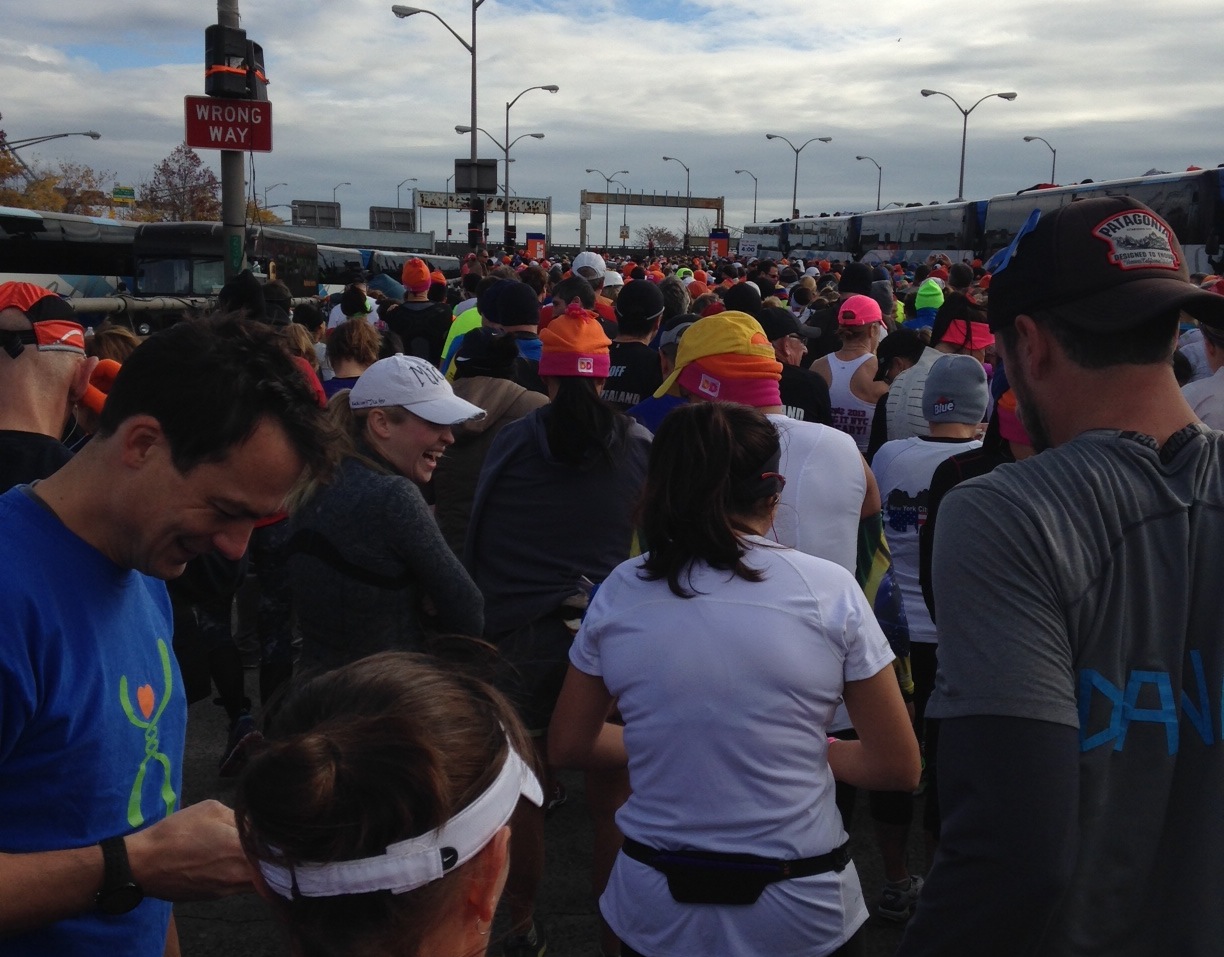
Start of NYC Marathon

I have had the experience of watching an actress – who I think is very talented  – become extremely talented. Her capacities were always evident but her ability to employ them, to follow through, to fulfill her promise were somehow just out of reach. Then she became a runner and all that began to change. It was a mesmerizing transformation. At the moments where I had previously anticipated a flag, fearfulness, this actress now knew how to dig deep and make it to the next mile marker.

photo (23)
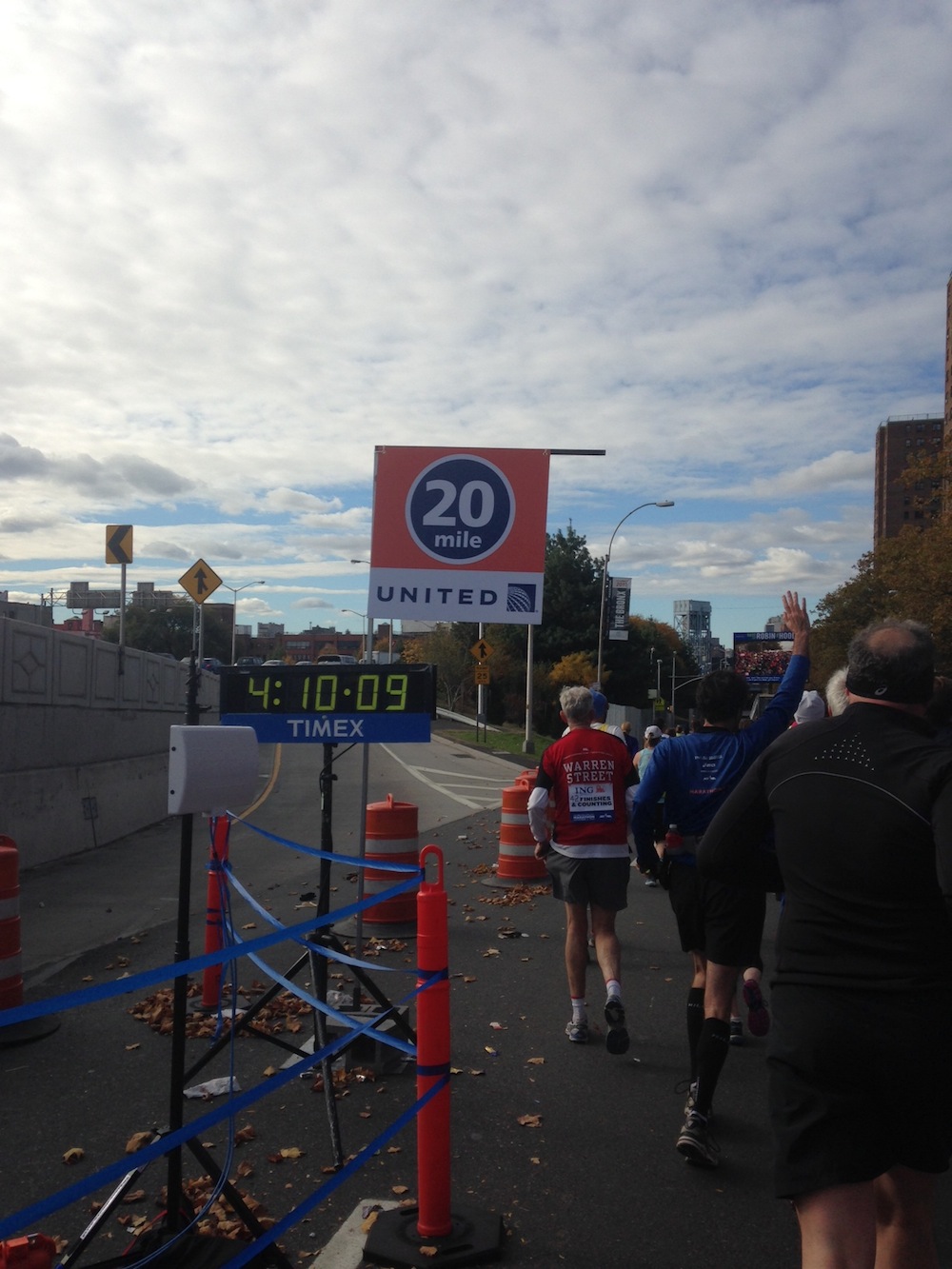
20 Mile Marker

At mile 20 of the 2013 NYC ING Marathon, this was a good thing to remember.

I started running because of Mr. Lloyd. Now he was something. Blond hair thinning on top, double-jointed knees and elbows, a funny front tooth, and a plaid sports coat that lapped his tooth pick frame as he walked. I was in love with him. My gay  – completely non-flamboyant – teacher who was dying of a mysterious wasting disease that caused him to quietly leave the school and end up in an apartment just down the street from where I was living in Toronto. He had me over for tea. When I was in high school Mr. Lloyd was the first person to actually make me weak in my knees.  Mr. Lloyd was one of two drama teachers in my high school. The total population of the school was 296 and we had two drama teacher and two theatres! This captures: “those were the days my friend”. That and privilege.

Yesterday I was surrounded by 50k plus similarly prepared runners making a start at Staten Island. It is amazing to find yourself enveloped by so many who have gotten up in the dark to lace up shoes, or who have headed out after sundown, all in an effort to prepare for one of the biggest community engaged shows on the planet. The respect and love I felt for each of the unknowable people who flanked me was sincere. And the question as to what made them choose to perform there, in New York, on a cold November morning will remain unanswered.

But for me the question takes me back to high-school drama. (Frank Zappa apparently said “the older you get the more life’s like high school”) Mr. Lloyd did the musicals. He also did the Broadway hits. David and Lisa, Butterflies are Free, The Pajama Game, and South Pacific. He was one of those stage-managing directors. He said very little to the actors: always watching, always respectful but never verbose. The other drama teacher, Mr. Lewis, was a lean-in close kind of guy. He would get in your grill, say things to make you mad, and then lean back with a small grin saying: “yeah, that’s right, that’s what I am talking about.” Truth be told, Lewis’ work was always superior.

But there was something about Mr. Lloyd that kept me coming back for more. He was gay. So there was that. I felt safe in his company. And maybe I sensed that his silence was more out of societal expectations than linked to his essential being. Regardless, he was unknowable and this attracted me.

photo (26)He was also a runner, and not a beautiful one at that. He wore tennis shoes, jeans and a great big blue ski jacket and he would run laps around the school every morning. I know this because these same laps were punishment for any and all indiscretions we in our adolescence got up to. I ran a fair number of laps: horrible, cold, quarter mile hellacious penance for our sins. But there was Mr Lloyd, all double jointed and knock kneed circling the school like someone whose life depended on it. I think of this dependency while I run.

I returned to running when my heart was hurting, my spirit was broken and my connection to the theatre was in tatters. I ran and I ran and I ran. It was a glorious reconnection because there was no finish line, and next to no belief that anything outside of the run itself would make anything feel any different. At the time I was directing a beautiful play by George Rideout called Michel and Ti-Jean. It was a one-night encounter in a Florida bar just after Michel Tremblay’s massive success with Les Belles Soeurs, and days before Jack Kerouac’s liver essentially exploded. I needed to go to Florida. How did this Petit Canadien from Lowell, Massachusetts and his maman, end up in Orlando, and then, finally St. Petersburg? While my need for research was beginning to take shape, so too were my first steps back into the running world. St. Petersburg launched the first women’s half marathon, I signed up and two things, running and research, aligned as they have continued to do ever since.

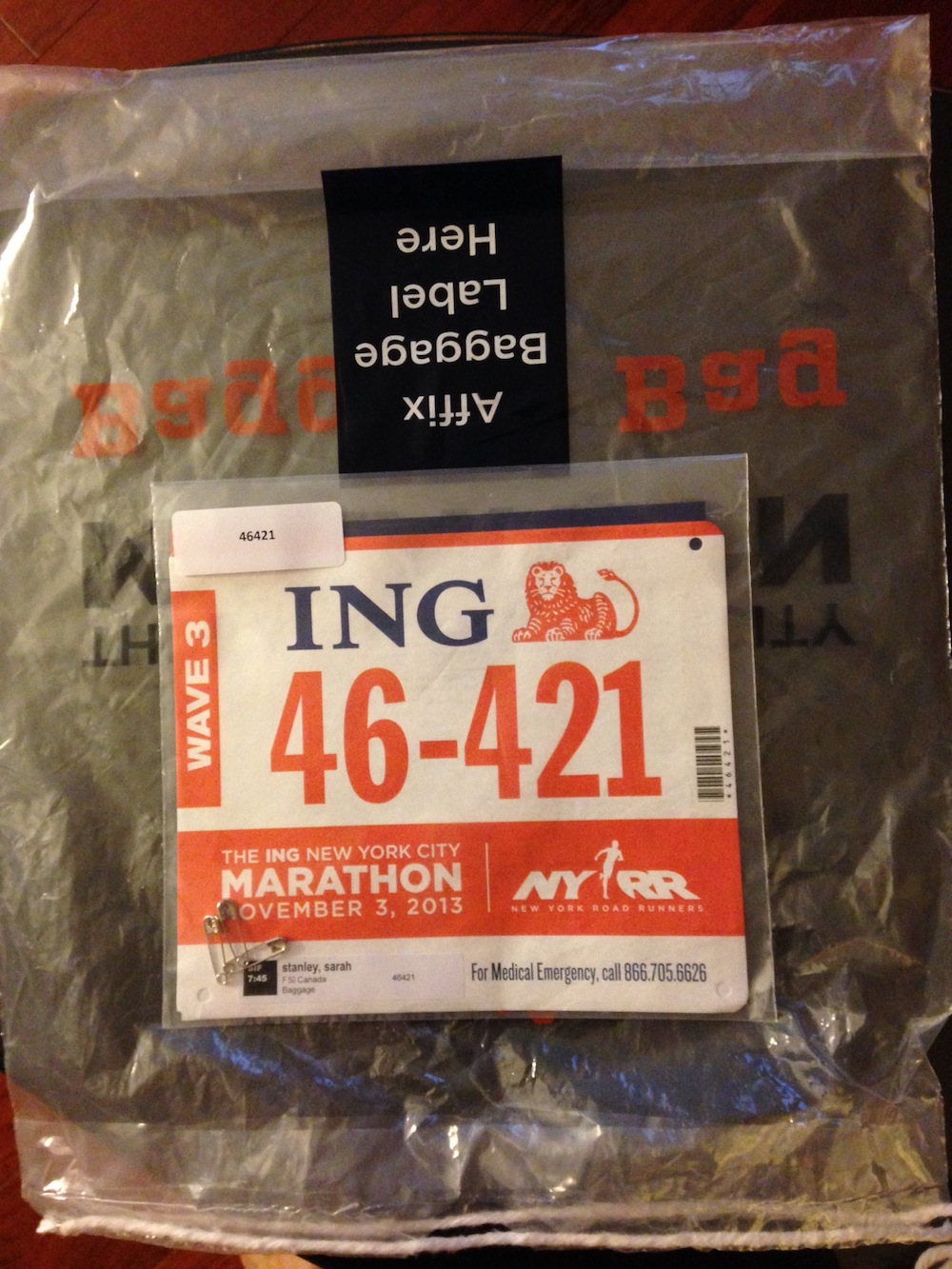
Yesterday I ran the NYC Marathon. I had this goal in mind from the completion of the half in St. Petersburg. During the lead-up to the opening of Michel and Ti-Jean, I signed up for another half in Austin, Texas. It was to be held on Valentine’s Day and this felt important to the state of my heart. On the mend, thinking about what shape my life and work would now take; it was a perfect thing to do. And now 4 years on, and 3 marathons under my very tired belt, I was given the opportunity to run over the Verrazano Bridge to Frank Sinatra’s New York, New York. And at 20 miles, where the wall showed her face I remembered Mr. Lloyd, and that actress, and my life in the theatre.

photo (27)
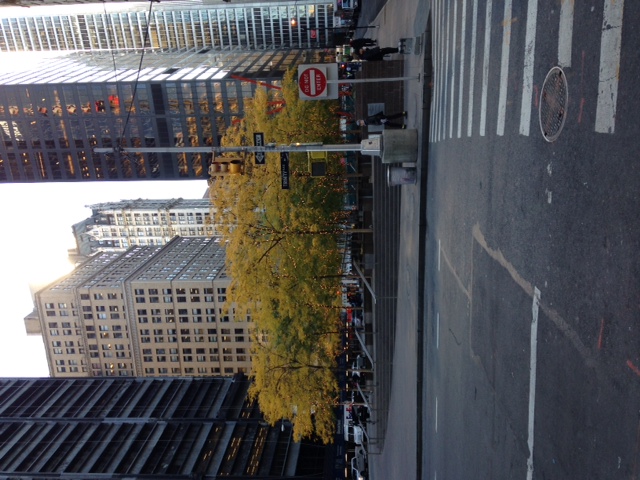
Zuccotti Park (Home of Occupy Wall St.)

There is a spine running through this life. Sometimes I lead the charge and sometimes the charge leads me, but the spine, like the route remains. If we are lucky, it is long, with unforeseeable twists and turns, and loads of eccentricities. But it is always there if you are looking for something to follow. 4 years ago, I completed my first 20 mile run and it took me about 4.5 hours to do it. I was aware upon completion, that I had just done the longest consecutive thing (outside sleeping and breathing) in my life. It formed a particular link to the mis-attributed Gladwell 10,000 hour rule.

The link goes something like this: Enter the tunnel, keep moving forward, do the work, if you remain injury free, you line up at he start and you begin the show. Mr Lloyd taught me that 90% of life is rehearsal and 10% is the show. He did this mainly because I was only really ever witness to his attempts, never to his transformations. He was always working at it, and the longer the rehearsal, the better the show. (If you get to live – which he did not)  Length is a curious thing. A mile at 25.1 can last a lifetime while a mile at the start can finish before you or your body can grasp it. Mr Lloyd never gave up. He has me for tea, he allowed me entry into what must have been a harrowing last couple of moments in a life. All with an eye to finishing. The show is not over until the show is over. And as with the runner who becomes a runner by being a runner, the show can only end when the finisher makes it to the end. And that can only happen: “by getting up really early in the morning and working really hard all day”[1]

* Sarah completed the marathon in 4:30:09 and because of this she made it onto the top 32,820 list in The New York Times.


[1] Philip Glass in Answer to Denise Clark’s onstage question about how he accomplishes all that she does during High Performance Rodeo 2002


Why Theatre?

WhyTheatre

With each production that I create, each new play that I workshop, and each play that I read, I begin with the question, why theatre? Allow me to clarify: We live in an age of consumerism, where the arts are continually asked to justify their existence. My question “why theatre?”, however, has NOTHING to do with validating the worthiness of an artistic response to anti-humanist political agendas. I refuse to engage in discourse around issues such as “the economic and social values” of art, the “creative economy”, and so on. I ask myself “why theatre?” because the attempt to answer that question always connects me to the core human impulse behind what we do.

Over the years of asking myself “why theatre?”, I have come to identify seven primary human needs[1] that I believe the theatre satisfies. In Hebrew, the word seven is from a root word meaning to be “complete or full”. I believe that the theatre, in meeting these seven needs, completes our humanity.

  1. Interdependence: From the rehearsal process to the experience of live performance, the theatre presents the world with a working model of cooperation, collectivity and community. This makes the theatre essential to a world where the pursuit of individual wealth and consumerism is leading us to economic, environmental and cultural collapse. The theatre provides citizens with a space to experience the joy of togetherness.
  1. Empathy: One of the most powerful pieces of theatre that I have seen was a show entitled Rwanda 94 created by a group of survivors from the Rwandan genocide. Over six hours, these survivors, witnesses, musicians and actors told the horrific story of that nation’s encounter with mass murder. The physical presence of these people who had faced unspeakable darkness prevented me from dissociating myself from the experience; I could not hide behind the protective veil of television or film. I left the theatre transformed. This show truly taught me that the proximity, ‘liveness’ and immediacy of the theatre allow us to directly experience the world of another person and to learn – intellectually and emotionally – about others. The theatre taps and develops our capacity for empathy.
  1. Entertainment: One cannot ignore or underestimate the power of entertainment in the theatre. We all seek diversion from the normal patterns of our lives. In being entertained, we escape our daily situations and gain some perspective on our existence. A great piece of theatre that combines entertainment with artistry, intelligence and complexity reveals truth about the human condition and inspires us to become better people.
  1. Spectacle: As humans, we need to believe that things are larger than us. The unique power of spectacle in the theatre lies in the fact that the scale of theatre is limited by the scale of our bodies and that the theatrical event occurs live, in real time, in front of our very eyes. When spectacular things happen on stage, the stunning potential that lies within our own corporeality is revealed.
  1. Ritual: As a young boy, I did not go to church for god – I went to sit, kneel and stand with a group. The repetition of the group event gave my life meaning by creating a sense of familiarity and order to my existence. Similarly, the communal and ceremonial nature of the theatre event fulfills a profound yearning for ritual in our lives. I seek to honor this aspect of the theatre at every juncture of the creative process, from rehearsals to performances. 
  1. Engagement of the imagination: Years ago, I created a children’s play. At one point in the show, a character delivered a short monologue that recounted the story of a pirate ship sinking after being attacked by a whale. It was simply told with the usual gusto found in children’s theatre. After each performance, there was a talk-back where the kids were asked to share their favorite moments in the show. Almost always, a child would talk about the moment when the whale came on stage. We never actually had a physical representation of a whale in the show – the actor only spoke about it during his monologue. This taught me a valuable lesson. Theatre does not happen on stage, it happens inside the audience’s head. Great theatre invites an audience’s creative participation by inciting them to build a world around what is happening on stage with their imagination. The theatre allows the audience to be active creators in what is being presented to them as opposed to simply being passive receivers.
  1. Transformation: At its most elemental, theatre is about transformation. The actor is transformed by the character. The character is transformed by the plot. The audience is transformed by the experience. In theatre, we find confirmation that human transformation is possible.

I often choose plays that venture into uncomfortable or unknown territory. I am driven by the desire to find new approaches to performance, to present alternative points of view, to question established norms and to push boundaries. As I delve into the unfamiliar, this list is my anchor. It reminds me that the pursuit of theatrical innovation is, in fact, an attempt to reengage with the original power of the theatre and to renew this gloriously ancient form. The original definition of the word “radical” is relating to, or proceeding from a root – this is my work as a director.

[1] Special thank you to Anne Bogart for inspiring the format of this list and thank you to the countless mentors, thinkers and collaborators who have led me to these notions.

This post originally appeared on the Buddies in Bad Times Blog.

A Utopia crumbling with hopeful dreams of 1993

2012-Farewell-Aarhus-FOTO-Martin Dam Kristensen-02 (1)

I moved to Montreal in late 2009 after living and working in Toronto for 15 years.  I had visited Montreal quite often before, a devotee to the Festival Trans Ameriques since 1997 where I would always see 2-3 shows every couple years.  I always found it an exciting, mysterious and beautiful city that I enjoyed immensely every singe time I visited.

I began working here in 2005 and loved it even more, the audiences seemed more engaged, the spaces bigger, more exciting and the work I was seeing was exhilarating, daring and contemporary.  Performing in a giant art gallery and then being able to return for the FTA in 2009 and have a dream come true and perform /dance/songs/ with Public Recordings at Theatre La Chapelle.

Montreal is a paradise for many artists

The city seemed like a paradise; rent was way cheaper, there were more bike lanes then anywhere else in Canada, tons of incredible programming for dance and performance and a ton of more spaces for rehearsing and creating.  My wife had grown up and lived in Toronto her entire life so was also in need of a change and we both felt that if we didn’t leave in 2009, we never would.  Another big attraction to Montreal for me was the availability, size and beauty of most of the apartments I had seen in Montreal over the many years.

One of my goals in moving to Montreal was to focus more on my own practice, creating multi-disciplinary collective creation pieces.  In my research I felt confident Montreal was a much better city for experimental and performance based work.  What I didn’t have in Montreal was a job, any connections or a grasp at all on French.  These were just some of issues I should have guessed would set me back here in a huge way.

Why did you move to Montreal?

This is a question that kept coming up more and more from almost every single person I met and I still get to this day.  It is often said in a tone that says “You have made a great mistake and will regret it sooner or later”.  While this might be paranoia it did seem strange that so many artists I met here who seemed to love their city in a way I do not usually see in Canada seemed to also not know why any English artists move here.

IMG_0872I have found in the four years I have been here my optimism about this city does get slowly eaten away.  The community I thought that would exist here for contemporary performance did not and was a scattered group of incredible artists (Jacob Wren, Alexis O’Hara, 2boystv, Clea Miniker, and many more who I am missing) who toured a lot and were not in Montreal very much.

A couple of places have really saved me while I have been here, Studio 303 and Playwrights Workshop Montreal.  Both have been institutions that have continued to support my various projects and ideas over the years.  With amazing leadership from Miriam Ginester at 303 and Emma Tabaldo at PWM, I have been able to explore, fail and work out idea’s in a judgment-free environment but also with supportive feedback.

I have been told a few times in Montreal that if you do your own thing (open a space, have a monthly event, make your work) here it is easier then waiting for work to come to you.  Montreal does still have some of the most affordable cities to rent spaces in and the thought of running a space here is a possibility that seems more like a dream in Toronto or Vancouver (but obviously still happens).

I am in midst of starting a new performance collective of independent creation makers based here in Montreal and I am really excited to attempt something I have never done before.

Make your own community

I need to make the community that I want to have, a community of idea sharing, resource sharing, help each other tour more, help each other make grants a little easier (proofing, last minute support) and helping around shows when it often feels like we don’t have anyone to help us out.   The plan is meet at least monthly and figure out what need each month and how to best use our time, resources and energy.

I love Montreal, miss Toronto dearly (and love going back) and feel blessed to have been able to work in Halifax, Vancouver, Calgary, Edmonton, St.John’s and soon Victoria.

Montreal is a great place to fail and to find out what you want to do.  It has a forgiveness that is needed in a time when many artists feel an incredible pressure to make every project a success or fear they may never get another chance.

It is not what it once was in 1993 but 20 years later it still offers a chance to not just survive and get by but to try something you may never have before.

#CdnCult Times; Volume 1, Edition 4

Why? Why do we do anything?

In this edition of the #CdnCult Times, our contributing theatre artists reflect on the why of what they do: Where they have chosen to live, why they practice their craft, what they chose to do with their (theoretically) non-theatre time.

This seems an essential question in the performing arts – so often we are so busy doing, it is easy to forget to ask the question, “But why am I doing this?” 

We all have different answers: personal, professional, spiritual. As an increasingly efficient and product-driven world ushers us through space and time, stepping back to ask the question, “Why?” seems crucial.

Michael Wheeler
Editor-in-Chief: #CdnCult Times