



Page 58

Geographic Correspondents: What influences your work?
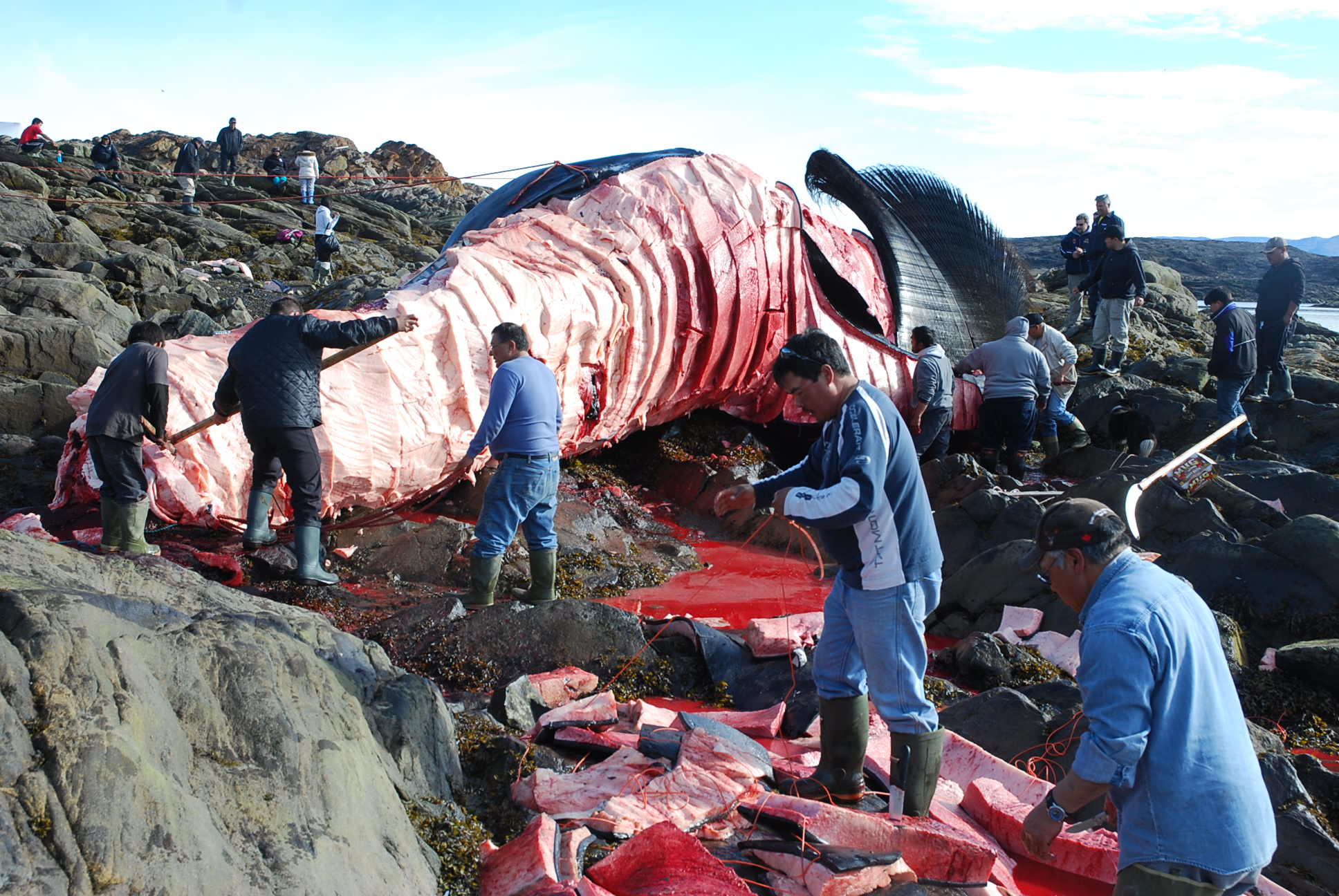
Iqaluit butchering the first bowhead whale caught in the area in 100 years in 2011

Matthew: Yes, today’s topic. Some artists place protest at the centre of their work. How would you characterize your influences?

Laakkuluk: Are either of you protesters by your own definition?

Matthew: No. Not that I am aware.

Amy: I thought about this a little this aft and I think I am totally inspired by community and women who make a lot from not much!

Amy: I don’t think I am a protester but I make statements in my work for sure.

Matthew: What do you make statements about?

Amy: I mostly make statements about family – husband/wife stuff, mother/children and politics.

Laakkuluk: I find myself being politically active as a performer and in public outside of performance.

Amy: Yeah, I am an advocate for the arts for sure and follow politics in our province closely.

Laakkuluk: In fact in a fun little circular way, I got called a “drama queen” in the comments section of our local paper today.

Matthew: Are you?

Amy: Ha! What did you do to garner that handle?

Laakkuluk: I organized a solidarity march for the anti-fracking protesters in Elzipogtog.

Matthew: Nice.

Amy: We have protests against fracking here in Newfoundland as well, on the west coast.
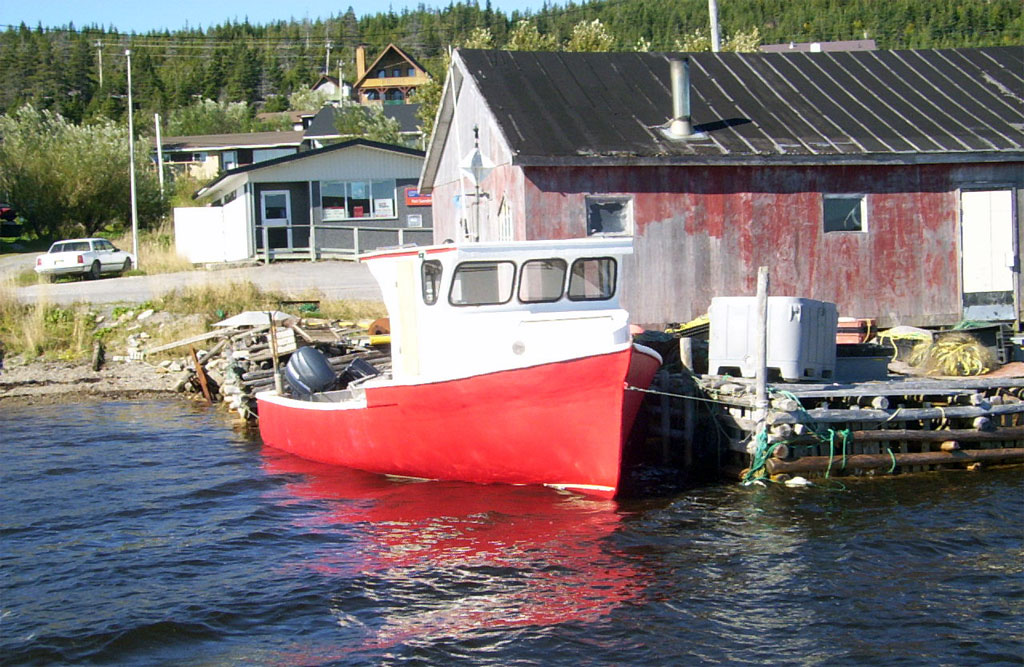
Fishing Boat Pt. Saunders

Laakkuluk: Probably for the same bodies of water!

Amy: As I would say if I were there, “Frack that!”

Matthew: We heard about that protest all the way out West.

Laakkuluk: It was a pretty startling event.

Amy: Laakkuluk, do you think this will find its way into your work?

Laakkuluk: We made Idle No More statements in our last production, mixing it with raven mythology that was collected by Knud Rasmussen in the 1920s.

Amy: Yeah, I guess that is what happens: big, meaningful events do end up in our work one way or another.

Amy: Matthew, the show you are doing now, is it inspired by your home?

Matthew: It is about a cattle drive through BC in 1864. So yes. The play also recounts three actual British Columbia events, one of which is The Chilcotin War. This was between a First Nation and white Settlers. The war is very relevant today as the Nation has never surrendered and therefore claims rights to their land through this means, as well as others. I guess I worked it in to my work.

Laakkuluk: You do work politics in, but you said you are not a protester?

Amy: I feel if we are aware of what is happening in our community we can’t help but bring it in into our work. It is top of mind when we create.

Matthew: Yes. Maybe I am a protestor.

Amy: We can protest without placards and signs…the mighty pen and the act!

Matthew: Nonviolent resistance. Okay, what about influences?

Laakkuluk: What pictures are you each submitting for this assignment?

Amy: I plan to submit a photo of my Mom, My Aunt Mame and a photo of a boat/fishing village.

Matthew: I am submitting a picture of Joan Mans. She is a little old lady who was a best friend of mine. She lived 1925-2010. My next play is about her. Right now there is a cast of three professional actors and two ensembles. 24 kids and 24 dancers.

Amy: Beautiful! I can’t wait to see it. What inspired you about her?

Matthew: Her journey through extended health care was tough and she struggled to keep her spirit. In the end I think she did. I miss her and think great thoughts of her often.

Amy: Wow. Where will you do this, in Victoria?

Laakkuluk: it sounds like an entire movement around her story. I like it a lot!

Matthew: She was a pretty key figure in the arts here, volunteered everywhere. Yes, Victoria to start, but hope to work with ensembles elsewhere.

Laakkuluk: I’m sending a picture of Iqaluit community members cutting up a bowhead whale.

Amy: OMG. That is fantastic. So we are all influenced by place and great women!

Amy: Did you take part in the bowhead hunt?

Laakkuluk: I wasn’t on the hunting party, but my family went to help butcher after it was caught. I’m looking at a piece of baleen we took right now.

Amy: Will you make something from it? I remember as a child on the beach collecting pothead whale teeth. A big bunch of them ran ashore in Chapel Arm, years ago.

Laakkuluk: Lots of people make amazing jewellery and artwork. But I love just having the raw piece. It’s so big and surreal and lovely.

Amy: Yeah, I know what you mean about having the piece untouched.

Laakkuluk: Maybe we can answer what the characteristics of our influences are.

Amy: Hmmm, what exactly does that mean?

Laakkuluk: I think what we draw from our influences.

Matthew: What are your influences Laakkuluk?

Laakkuluk: If I were to talk about why that whale hunt is an influence, it would be a collaborative connection to the land.

Amy: I draw sustainability. The people who inspire me are usually underdogs of some sort. Persistence in the face of adversity

Laakkuluk: Would you call that resilience?

Amy: Yes, resilience is good. These people I speak of bring me joy and hope.

Matthew: Joan was an underdog for sure, persistent and tenacious. Resilient.

Amy: Yes Matthew, I love her already….
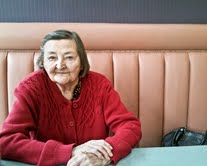
Joan Mans_ May 2010_by Pamela Bethel
Matthew’s influence – Joan Mans

Laakkuluk: Awesome!

Matthew: OK, I have to go find a new set. See you soon.

Laakkuluk: Good luck! See you!

Amy: Look forward to it. Good luck Matthew with your set and Laakkuluk with the children’s teeth

Laakkuluk: Take care Amy! 🙂

Matthew: Man, someone has to teach me how to do emoticons in this… Ciao

Matthew left the room.

Amy: how do we get out, just close?

Laakkuluk: I believe so

Amy left the room.

Laakkuluk is left alone in the room. She makes funny faces, but no one even sees her. So she leaves too.

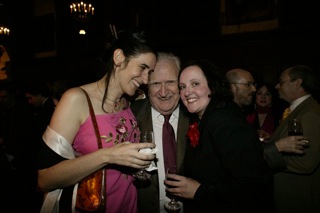
 

Shake your money maker

I believe I’m here tonight as a good example of the the depth of impact this kind of award can have on one person.   I make for a good story – at the time that I won the prize, I was working full time out of my laundry room. All Temperature Cheer served as a paperweight for my scripts and dramaturgical research and I had to unplug my computer to use the iron.

jillian 2
Jillian Keiley, when she won the Siminovitch Prize in 2004

Now, through no small influence of this award,  I’ve got an office on the Rideau Canal and I’m one of those arseholes who gets invited to galas.  BUT I believe  the Siminovitch prize is greater than the good it does for one person.  It’s an acknowledgement from the Siminovitch Family, from the founders and the corporate donors, that the Theatre is an important discipline.  We can’t empirically define and measure its impact, but we know, we feel that it has an important place in the world.   To have Scientists and Financiers acknowledge the immeasurable weight of something people can only feel has a massive value.

Now I will shake my money maker.  

This here – my gut – is how I make a living.  I watch hundreds of shows a year with my education, professional experience, eyes and ears backing up my analysis of a production.  But my most important tool is the one I cursed this morning trying to put on last fall’s jeans.

Jillian 1
Jillian Keiley, Lou Siminovitch and Danielle Irvine

The three directors we are celebrating here tonight, are all in the business of making work that impacts your gut, the place where you feel.  It’s an alchemy with no formula, and its singular stimulant is the presence or lack of what I’ll call ‘beauty.’  These three directors’ visions couldn’t be more varied, but they’ve all made their mark in Canadian theatre by creating extraordinarily beautiful work. In my new job at the NAC a lot of my task is to try to determine or distill what is beautiful.   I think about it all the time.

I’ve got thousands of subscribers.  People from all walks of life, young people, very old people –  people of different religions, cultural backgrounds, races.  What they think is beautiful must be extremely varied and I know that simply by how they present themselves at the theatres, how they dress, the cars they drive or refuse to drive.   I make a giant assumption that if my gut is moved by the beauty of something, my audience will be too.  We recognize beauty because we feel it, down here.  And in the best theatre – I believe that beauty is a recognition of a deeper commonality – our shared experience, and our shared humanity.

photo (22)Theatre Specializes in showing us the beauty of humanity itself.  The visual and aural aspects of a production demonstrate the limitless capacity of human invention and craftsmanship while actors and writers create mirror worlds for us to see ourselves in – to laugh at ourselves, to fall in love with ourselves and to forgive ourselves.      I don’t know any great director who doesn’t see great humanity, especially in the least savory characters. They know the adage “Everyone is Lovable once you know their story.”   If a director can delight the senses and guide the actors through to an audience’s recognition, I truly believe we have done a good thing for humanity.  While that can’t be empirically proven,  I feel it, and my feelings have served me well so far. I may even embrace them and move up a Jean size.

To the Founders, BMO who originally sponsored the Siminovitch Prize, the continuing support of the Siminovitch family and now the Royal Bank, I commend you for trusting your gut and the feeling that something beautiful will come out of this night too.

@jillkeiley delivered this speech @siminovitch100k Awards in Toronto, Ontario on Monday October 20, 2013. The recipient was @chrisjabraham and his mentee was Mitchell Cushman

Why we’re touring Canada with a play about G20 Toronto

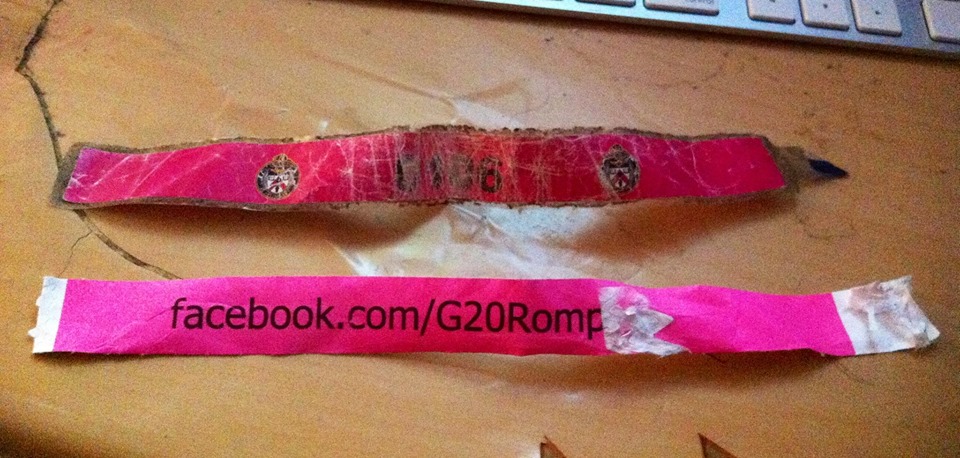
The wristband Tommy Taylor was made to wear when arrested at G20 with prisoner number on it, 0106  Below it, the wristband worn by participants in You Should Have Stayed Home.

I only knew their first names – didn’t learn they were The Wheeler Family until after they had left.

Jimmy and Zephyr Wheeler had driven from Dawson City to Whitehorse in a school bus on a family vacation with three somewhat-dressed children, homemade toothpaste and hand-rolled cigarettes in tow. Using the library to check email – they saw a call for participants to recreate the conditions in the detention centre at G20 Toronto and felt compelled to participate. With no cell phone, they used the library’s phone to receive a call from The Yukon Arts Centre to discuss their proposal:

Could the entire family be in the show? This included their four and eight-year-olds.

The Wheelers are a few of the approximately three hundred Canadians we anticipate will have participated by the time we conclude our tour of You Should Have Stayed Home: A #G20Romp. Just like the 1000 + people swept up and detained that weekend – our cast has been all genders, ages, ethnicities and classes. Our tour of Whitehorse, Vancouver, Toronto and Montreal concludes at The Arts Court Theatre in Ottawa.

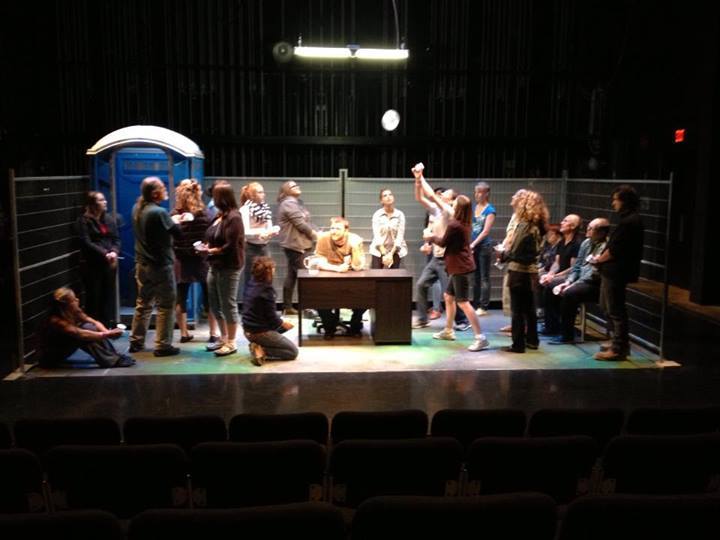
Detainees in tech rehearsal at Yukon Arts Centre

It is our hope that on our November 20th opening night in Ottawa, in a theatre that used to be a courtroom, Members of Parliament will also participate in a staging of “The most massive compromise of civil liberties in Canadian history.” We really have no idea whether we will succeed at this goal. We have some leads, it is not impossible, but it is definitely a maybe.

The motivation for this approach to staging and touring a show about police actions at the G20 Summit in Toronto is to broaden the discussion of civil liberties and in particular, Charter rights, in an era when they are being whittled away. The problem isn’t just that the state could declare for a weekend “You’re not in Canada”, when citizens asserted their rights. Because there were no consequences, a precedent has been set: We are primed for a repeat, or worse, in the future.

With this in mind, we have created a production that allows the communities we perform in to include anyone who lives there and shares these concerns. Joining the #G20Romp is not just telling the story of what happened to over 1000 people that weekend, 95% of whom were never charged with a crime; it’s also standing up for the idea that this should never happen again. It is an art-based form of protest, that hopefully won’t get you arrested, that advocates for the position that if you are peacefully protesting on the streets – you also shouldn’t be arrested.

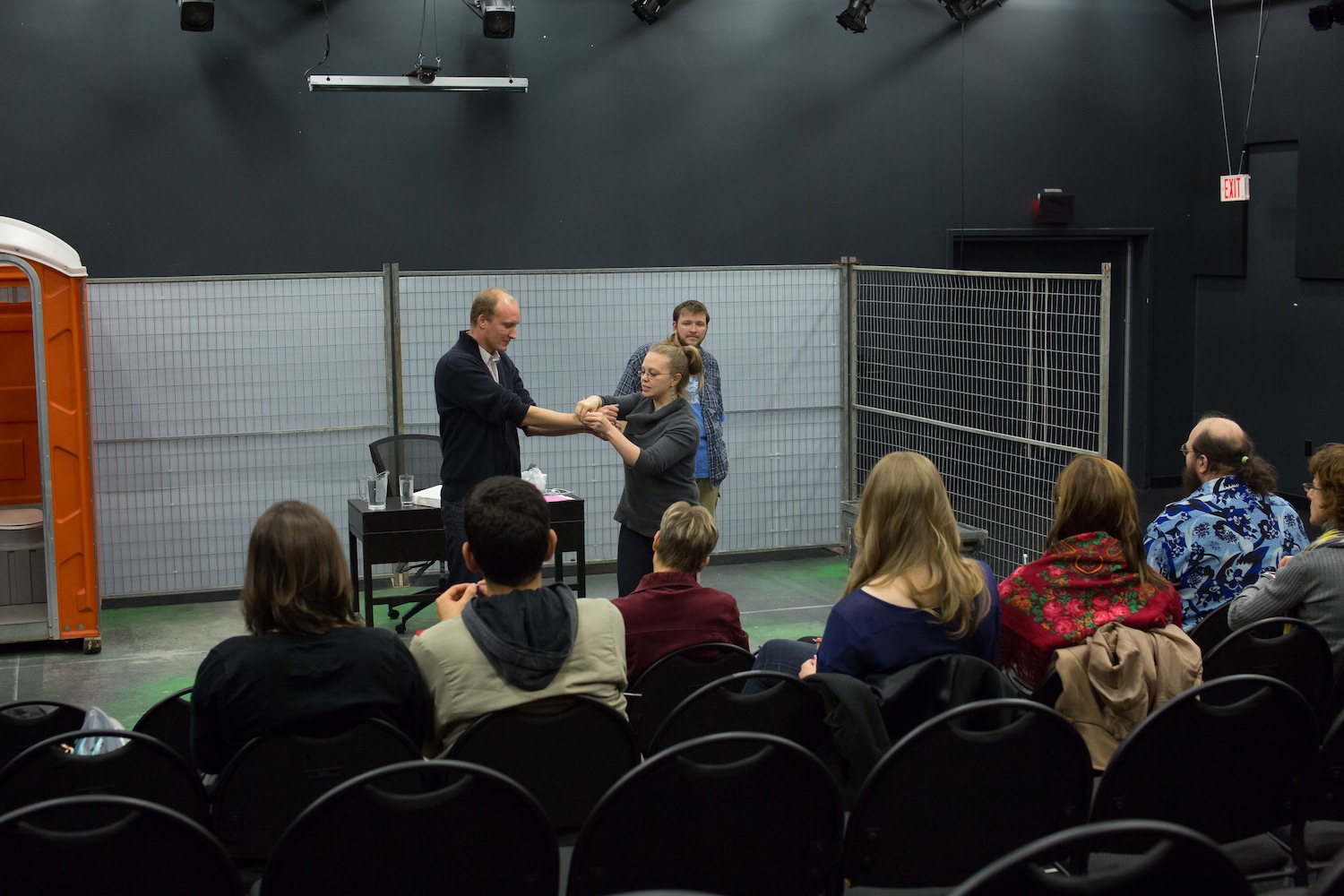
Praxis Artistic Producer Aislinn Rose demonstrates how to be safely zip-tied while writer performer Tommy Taylor looks on.

As a director, this approach has created particular challenges to presenting the work with a rotating cast that changes size on a daily basis. Throughout our run we have performed with anywhere between eight and thirty participant performers (we did one with 40 people at SummerWorks in 2011). To facilitate participation, we have created a system where anyone, regardless of experience, can learn their role by arriving at the theatre one hour before the performance.

We begin by introducing ourselves, our goals with the show, and demonstrating how to safely wear the zip ties that are were worn by prisoners in a cage in violation of The Geneva Convention. The set we perform on is introduced, which is an approximation of one of the 10 x 20 foot cages with open-door portapotties prisoners were detained in during The Summit. Some brief guidelines follow:

No one needs to invent a character to play. Participants play themselves if they were swept up in a mass arrest while writer/performer Tommy Taylor continues his monologue as the narrative arrives at The Detention Centre. In terms of position on the stage, there is no ‘front’ to the cage – it is possible to face any direction, not just the audience. The rehearsal moves through a series of ‘living tableaus’ that depict conditions in the cell. There is also a moment where having been denied water for many hours, the cage comes to life with a water riot. This moment is counterbalanced by a moment of levity when the entire cast plays a game of volleyball with an inflated (industrial) condom – a scene that happens somewhat differently every night.

Some of The Raging Grannies joined the show in Vancouver.

Bottom line is all of this, plus a curtain call rehearsal, has to take place over forty minutes for the audience to be admitted to the space on time. It means being organized and specific, but also open, friendly and willing to answer questions. For some it is the first time they have been on stage since high school. Rushing through isn’t an option. It is an exciting challenge for a director though, to re-direct a scene for every performance. No piece of theatre is ever the same twice; this show had reinforced this inherent characteristic of live performance for me.

When the Wheeler Family performed in the show in Whitehorse, we arrived at an arrangement where their extremely well-behaved children were babysat while they were onstage. Four to eight-year-olds were probably the only kinds of humans not detained at G20 Toronto. As they were leaving the theatre after the show, I ran up to say goodbye and thank them for participating.

Jimmy looked me in the eye, shook my hand and said, “Anything we can do to help.”

I responded, “Well, maybe we’ll get somewhere with this. Or not, you never know.”

He paused looking at the floor, “Well, if not, at least we’ll leave some good looking corpses.”

Then he turned and left. That’s the last thing any of the Wheelers said to me.


#CdnCult Times; Volume 1, Edition 3

This week’s edition of the #CdnCult Times concerns those core factors that motivate us as theatre artists. What is is that pulls us out of bed in the morning? What influences keep us working long after we should have gone to bed? Where do we find meaning? Is it our work, our communities, our collaborators?

These pieces by our Geographic Correspondents, NAC English Theatre AD Jillian Keiley and myself all take a different perspective on art, meaning and making theatre. Please feel free to engage with us about what motivates you if you feel  inclined. Our comments section is now up and running.

Michael Wheeler
Editor-in-Chief: #CdnCult Times


Collectivity

Sarah1

Collectivity: The quality or condition of being collective. Collaborate: To work together especially in a joint intellectual effort or to cooperate treasonably, as with an enemy occupation force in one’s country.

A 16-year girl knows how to wrench her father’s heart.

Too young to vote, while growing up in Montréal, I placed my fervour in the hands of the Parti Québécois and the cigarettes, women, and hair of René Levesque; a man who refused to be cowed by what my young mind understood to be “the establishment”. My first twist was for the promise of a split Canada. But the real wrench overshadowed this with a cool, even calculated cruelty when I told my fiercely devoted-to-Canada father, that I wanted to move to the United States. Both of my claims remained words on the wind, and ruptures on my dad’s heart, as I did not follow through on either.

photo (20)I was reminded of this when reading Alexander Offord’s extremely erudite (thank god for online dictionaries), oft-witty and intermittently accurate response to our opening essay for our first edition of #CdnCult Times

“Look, I think we are in very divided times…” says Alain de Botton and I agree. Allow me this unexamined de Botton digression, as he is an interesting guy, worth getting to know.

One of the most compelling things in Offord’s response was the knee-jerk reaction to the use of the word “collectivity”. Internal wiring led my brain to Margaret Thatcher: “There is no such thing as society.” I don’t actually know what she intended with this but together with a series of actions, there is no doubt that her supporters helped to shape a generation suspicious of disparate peoples, from disparate nations (both within and without the geo-politicized borders of Canada) being interested in anything together. This suspicion can’t help but apply to the wish for a National Theatre that might reflect Canada’s uniqueness.

My desire for “collectivity” has been with me for as long as my adolescent drives towards divisiveness. Theatre can –at its greatest – teach us of connection in ways subtle and transformative that few other things can. Its ephemera has us always reaching, always striving, yet its blood, sweat and poverty has us ever clawing, ever clutching to grab hold. It is why I included the second definition for collaboration in this post. There is an underbelly to words and while collectivity is under the microscope, I return to the second definition of collaboration, as a “principles check-up” for the decisions I take. Collaboration is, for me, one of the highest states of creativity, but one must be wary of the shadow. It is why, I trust, in a functioning society, the question of the value of a National Theatre will forever be asked.

Sarah 2

I believe in a National Theatre. I use: “believe” with the disclaimer that  my conception is not static but contains forward moving action, and that “believe” is essentially neutral: it does not presuppose an agenda as to how things will manifest.

Offord states: “The issue of a National Theatre of Canada (hereafter referred to as NTC), is a perennial one in this country.”  This feels true, but I don’t think it diminishes the presence of the question.

He goes on to say: “The fact of the matter is, we Canadians are deeply insecure about most things, & our theatre scene (I’m being hugely Toronto-centric in this, note; Toronto’s all I know, really), … has an inferiority complex for which “Napoleonic” is putting it mildly.

The use of the word “fact” is incredible here and so too is the use of a “we”,  or “our”, all of which leads to paradox of the “us”. How interesting.

Who the hell are we? Why can’t a Canadian National Theatre help us better understand ourselves?

photo (21)The world may be a lot smaller than we thought, but if “Cultured Canada” continues to exclude the vast majority of citizens on this planet, than this small-minded sensibility will both literally and figuratively crush us all. It was suggested to me that a National Theatre of Canada keeps getting seen as an unmoving lump of bricks and mortar. Why not, instead, visualize a swath of metal shards blanketing the land: each shard representing some awesome creative practice. While a magnet could pull it all under one roof, the strength exists by allowing this possibility to linger without ever exercising the right to call in the magnetic chips.

To my mind, the SpiderWebShow is an attempt to connect the invisible lines between these metal shards and to illuminate conduits between these pieces so that creative energy can flow through our collective space and bolster the whole damn thing. In this sense my belief in a National Theatre does manifest here in the action of revealing the breadth of Canadian theatre.

Since leaving Toronto, I have come to think of all of Canada as home. My “home” includes Toronto, but it also includes Peterborough, Guysborough, Whitehorse, Cow Head, Edmonton, Armstrong, Sackville, Meacham, Summerside, Yellowknife, Victoriaville, Iqaluit, Norway House, and on and on and on. And my hope is that, with the SpiderWebShow we can reflect a collection of theatrical selves back to ourselves, and create a renewed sensibility as to what our National Theatre looks, sounds, and feels like.

The question and the idea of a National Theatre must reflect the diversity of peoples and their individual expressions and practice, instead of attempting to discern one unifying principle. I am intrigued to discover that France’s governmental system is built on territorial collectivity and am encouraged to further think on Offord’s suggestion of disparate theatrical needs. Evidently I don’t believe that local needs and a National Theatre are mutually exclusive. Our nation is a collection of many nations. As Thomas Mulcair recently said on the House: “We need to speak nation to nation”. And I take this to mean that the government of Canada’s responsibility is to represent many nations within its borders. A National Theatre must reach to do the same.


“Post” my ass

Turtle gals
The Only Good Indian… Turtle Gals Performance Ensemble, Michelle St. John, Jani Lauzon, Falen Johnson, Cheri Maracle. Photo: Tim Matheson

An artist whose work I admire tremendously recently said to me, “ Your history is in ruins, it’s a barrier to moving forward, leave it behind.”

I think my colleague fancies himself post-racial, post-cultural.  It’s not a new argument, it is in fact the one we as First Nations have been hearing for – well – centuries.   It is the White Paper of 1969, the Indian Act of 1876 and its hundred years of amendments, the Gradual Civilization Act of 1857. All these acts were intended to help the First Nations here in what we agree to call Canada leave our ruinous history behind. It would be impolite of me to mention that these acts largely contributed to the ruination in the first place.

After a couple of hundred years of failed experiments in erasure and assimilation, I would like to suggest to my colleague that it is just not going to happen, we are just not going to get over it. His post-racial, post-cultural stance is antithetical to an Indigenous worldview, which insists on connections, connections between where we come from, our ancestors, all our relations, and those who come after, our descendents, whether literal or metaphoric, blood or art.

In the spring, I participated in the Idle No More iteration of Praxis/Theatre Centre’s Civil Debates. I was lucky enough to sit in the circle with Anishinabe artist/curator Wanda Nanibush and Anishinabe scholar Hayden King.  The resolution that we were to address was “that the issues that created the Idle No More movement require extreme methods to achieve change”.  In true Anishinabe fashion, we suggested that we eschew the parliamentary model of confrontational debate and instead sit in circle with whoever showed up to discuss the issue. At one point, Hayden referred the “Indigneous moral compass” that is so different from the values held by “Canadians”. When asked to elaborate, he offered three main ways in which the value systems differed: Indigenous worldview values community over the individual; women as leaders; and humility.  By humility, he explained, he meant an understanding of one’s place in the world, in relation to everything, air and water and animals and other people.

I was gratified to hear Hayden list those values extempore, because they are values I hold, but sometimes, watching the events of the world, the events in this country, I think I must be crazy to hang on to those values, much less try to live them.  And yet I do, I do believe that this worldview is the way we are going to move forward here, in a good way.

Rita-magistrate
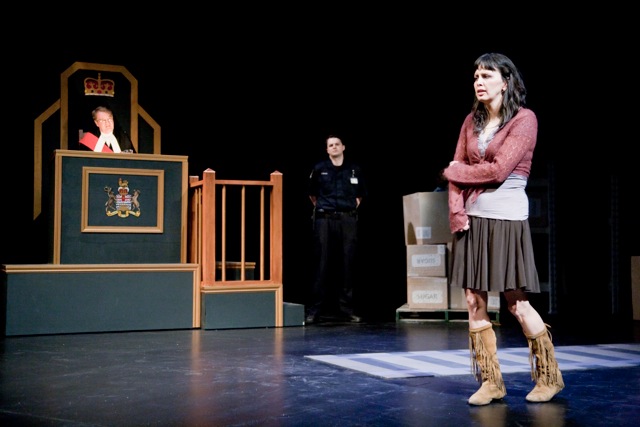
The Ecstasy of Rita Joe, National Arts Centre/Western Canada Theatre, Layne Coleman, Darcy Johnson, Lisa C Ravensberge. Photo: Barbara Zimonick

George Ryga was commissioned to write a play to celebrate Canada’s centennial in 1967.  The play he wrote was The Ecstasy of Rita Joe, which marks, arguably, the beginning of an indigenous (small “i”) Canadian theatre. The play he wrote was not a celebration of 100 years of nationhood, but a searing look at the relationship between the settlers and the First people, a hundred years on. Near the end of the play, the magistrate sentences Rita Joe to jail and dismisses her with “I worry for the child I once saw… I’ve already forgotten the woman!”  He speaks directly to her, and erases her in the same moment.

This is the problem with the post-racial, post-cultural impulse.  “Post” refers not to your culture and race and value system, but to mine. If I cannot become like you, then I am clinging to my ruinous history, and it is a barrier to me becoming like you.  And if I refuse to become like you, you can, like the magistrate, just erase me from your view.

But I am not unhopeful.  I feel a change a-coming. I think as more of us articulate the values of connection, of community, and of humility, we will start to see each other, and to see that we can belong to larger community, and that we have power. We have our bodies and our voices, we have our stories.  We tell those stories of how we got here, how we exist here together, on street corners and in theatres, online and in person, in small rooms and large.  My history is not just my history, it’s our history, yours and mine.  It informs who we are now, and how we go forward. All my relations.

Preternatural pronouncements from a European tour

I haven’t traveled much outside of North America, at least not since I was a teenager, when my father was posted abroad and we lived a gilded, expat business-class life. But in the last three months, we’ve taken the show Winner and Losers to seven countries in Europe.

One thing I’ve been struck by is my own desire to pronounce about other places. Three or four days in one city in a country of 5 or 10 million on continent of 750 million and suddenly I feel preternaturally qualified to tell everyone in Canada what it’s like in Iceland or Italy or Denmark. Of course, I’m too much of an intelligentsia chardonnay-sipper to say, “And the people – they’re just so nice!” but frankly it doesn’t feel that far off.  So with that in mind here’s a couple things I remember …

The economic collapse was real.

It’s been shocking to travel to Euro-places where the economy is so clearly fucked. And to realize how insulated we’ve been from the great recession and its five year fallout. How many times have I been reading the news and thought, ‘Come on, what economic collapse?’ Though it’s got its share of Filipino run, chi-chi Italian restaurants and 100-mile-diet cafes, Dublin’s homeless/transient/really-fucking-drunk population was a surprise.

For generations, Vancouver’s poverty and addiction has been quarantined in the Downtown East Side. Dublin’s was spread much wider. And it didn’t seem just like the really poor, either. Pretty much every single person we talked to has a cousin or sister or friend in their 20’s whose living in Vancouver or Sydney. Our petro-fuelled economy is putting them to work in the trades and looking after our children. Vancouver’s house prices are up 20% from their pre recession highs, which is why we’re losing young middle-class people in their 30’s who want to start families. Ireland (and Italy) are losing their young.

Marcus photoThe North is the North.

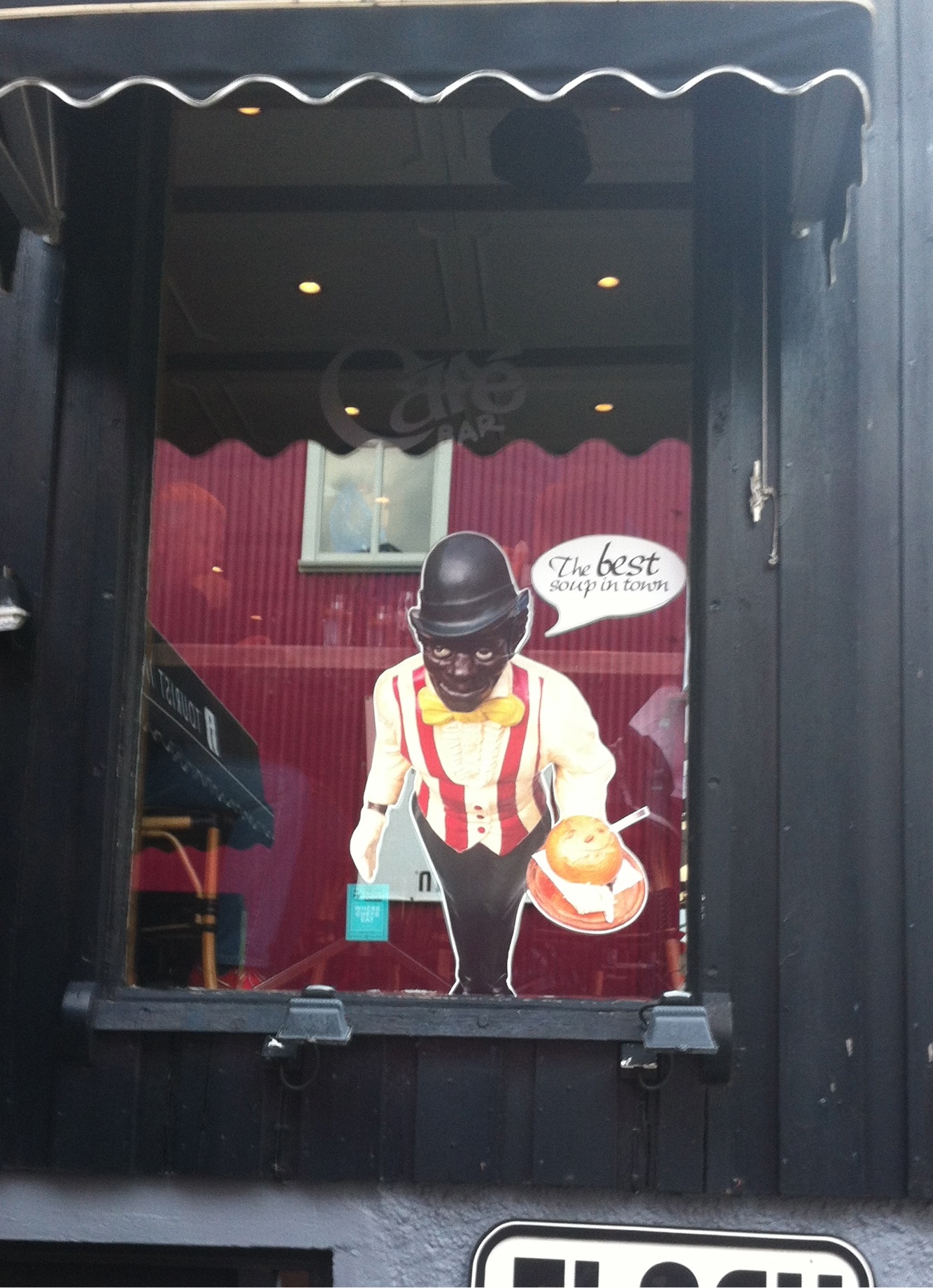
Iceland and Denmark – and even the Netherlands – felt a whole lot like being in Canada, minus the brown people. Something about cold climates and being from a place where the climate is, historically at least, a real threat; the constant presence of geography, in conversation and in people’s identity; an identification with the wild. Race, on the other hand, is a different story. Over and over again I’m reminded how, relative to Europe and with the exception of First Nations, Canada’s way ahead on race. Here’s a photo of a restaurant in downtown Rejkyavik. Feeling snacky? Head to the Dutch grocer store and purchase some Jew Cookies. How about the Negro Lips biscuit? You actually can’t get those anymore but our lovely host insisted that the name was a compliment – apparently it’s a pretty tasty cookie.

We’re Maybe Not as Feminist as We Like to Think.

Canadians pride ourselves on gender equality. But we’ve got nothing on Iceland. 40% of Icelandic members of parliament are women. It has the highest female labour-market participation rate in the OECD (82%), and the most comprehensive anti-violence laws as well. What was interesting to us was how, in normal relationships, we felt like we could tell. I’m going to get myself in trouble here, but … as an artist in Canada I work with a lot of powerful women of various ages. Almost all of them, to some extent or other, do what I sometimes describe as the female thing … the automatic body-language apology (smile and laugh a lot in moments of direct negotiation, shrugging, looking down or away). Our female Icelandic colleagues just didn’t, as much anyway, and it was interesting to become aware of the effect it had on me. I — shoot me now – treated them less gently, and talked to them more like I talk to my male colleagues. And I liked it. 

But we’re definitely more feminist than Italy, or: If I was Italian, I’m not sure actress would be my first career choice.

On my first day in Terni, Italy (industrial, steel town northwest of Rome, home of the Terni Festival), I got a ticket for a show that had me jump on the back of a motorcycle and listen to an iPod piece while riding through the gorgeous, pastoral Umbrian hills. After 45 minutes, the driver stopped at the intersection of an empty country road. He gestured to me to get off, pointed down the road, and took off. In an awesome theatre moment, I walked down the road alone, wedged between large fields of dying, black-headed sunflowers.

At the end of the road: a cliché-beautiful 20-something Italian woman with almond eyes and an ocean of curly black hair, in her bra and underwear, kneeling and staring at me through a full-length mirror. As I got close, she gestured for me to sit on an old, rickety chair. She slowly stood up and put on a bright summer dress. Then she filled a wash-basin with water, dipped a white cloth in it and gently, hyper-erotically (for me, anyway), washed my hands, face and the really tingly back part of my neck, maintaining full eye-contact the whole time. The encounter finished with her draping her hair back and forth slowly across my head and face, and then handing me a 1 inch sliver of mirror so I could watch her gaze at me as I walked back up the country road. A couple of minutes later, Dude with the motorcycle pulled up and I climbed back on the back of his motorcycle. The iPod narrator said, “I knew her for only a short time …” (of course!).

And in some fundamental way it was once again proven to me that what we think we see in others always seems to say less about them, and a lot more about us. 

#CdnCult Times; Volume 1, Edition 2

This week, contributors from Vancouver, Saskatoon and (nominally) Ottawa approach different questions with regards to a National Culture. These pieces are integrally related to last week’s edition, which explored the concepts that surround A National Theatre.

Our second edition asks questions about identity, history, culture and in some cases how theatre can work to alter and illuminate these relationships. As a unit, they reject the notion that we are post-anything, but that this need not be an impediment to understanding or illumination.

Michael Wheeler
Editor-in-Chief: #CdnCult Times

Geographic Correspondents: Is it possible to have a National Theatre?

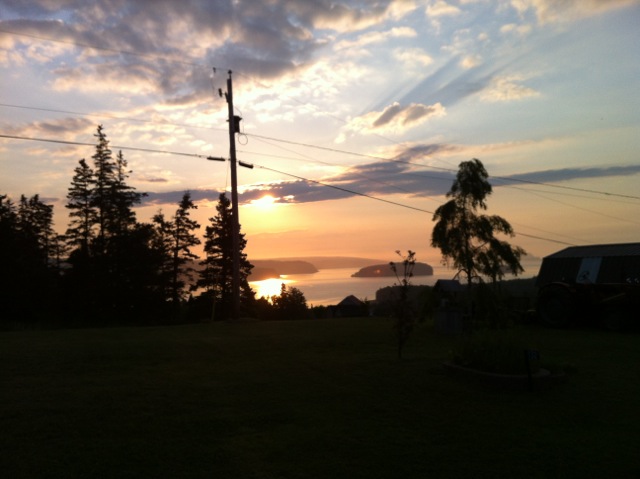
This is where Amy is.

Matthew: That is how one builds a National theatre.

Laakkuluk: By appearing with little blip sounds?

Amy: “Is it possible to have a national theatre?” Big Question for a big country.

Laakkuluk: Do you two know each other?

Matthew: No.

Laakkuluk: I like the idea of us all coming from 3 very far apart points in Canada.

Amy: I looked you both up on the web. Do you feel isolated where you are, from other theatre companies?

Laakkuluk: Absolutely! It costs $2000 return to get here from Ottawa. $1500 return Iqaluit-Nuuk and only during the summer months. It’s so expensive to get other artists to and from Iqaluit, Ottawa, Montreal, Nuuk.

Amy: Yeah, same with trying to get off the island of Newfoundland.

Amy: Matthew, you are going on tour with your show now?

Matthew: Yes, just to Kitchener, ON. MT Space will host us Oct 24-26. A Halifax appearance has been rescheduled to 2014.

Amy: Laakkuluk. I saw you drumming. Do you tour?

Laakkuluk: I do tour. The show I’ve been working on and travelling with most lately is called Tulugak or Raven in English. We’ve done the show here in Iqaluit once, twice in Nuuk, did a residency at the Banff Centre and a run at the NAC this year. We have 20 artists from Greenland and Arctic Canada.

Amy: Big show. Wish you could bring it here.

Laakkuluk: We’re invited to perform in Norway next summer. Wish we could come too!!

Amy: Wow, Norway.

Laakkuluk: We’ve been invited by Riddu Riddu, an indigenous festival in northernmost Norway.

Amy: Did you apply to the Festival or did they scout you out?

Laakkuluk: They came to see us in Ottawa in May and again in Nuuk last month.

Amy: It is so expensive to move theatre, to get exposure in this country. That is my experience with RCA Theatre Company.

Laakkuluk: How many times a year do you both find yourselves travelling across Canada for theatre?

Matthew: I visit Vancouver about six times a year. I go to Mag North most years.

Amy: We can search the net to see who is doing what, but if we don’t have a point of reference… Matthew, do you find this keeps you connected?

Matthew: Yes -SKAM has been part of the Hive series. A great way to stay connected. The recent series with those peers was too prohibitive- travel wise.

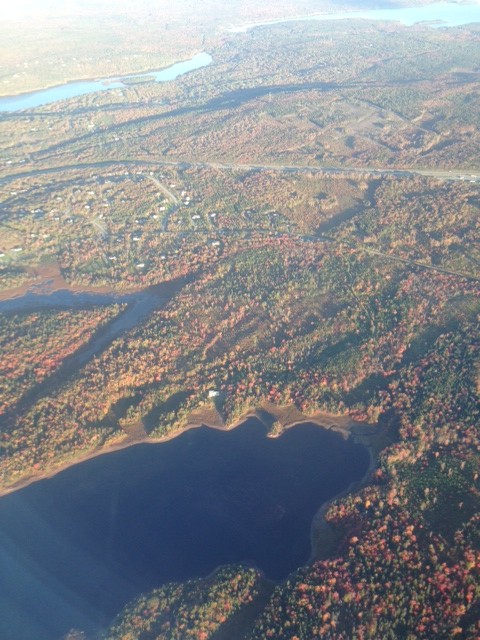
This is where Matthew is

Laakkuluk: Matthew- you don’t live in Vancouver?

Matthew: Victoria. I live on Vancouver Island.

Laakkuluk: We’re all on islands.

Matthew: Takes four 1/2 hours by car and ferry to Vancouver. Plane is 25 mins

Amy: Expensive?

Matthew: $178 or so.

Laakkuluk: That’s ridiculously cheap.

Amy: To get a flight out of here it will be no less than $500 and that is a very good seat sale.

Laakkuluk: As a Canadian artist living on a coastal island, is it more important for your career to travel, or to incubate things at home?

Matthew: Right now I have seen enough and need some time at home with my practice. Incubate. However that is a cycle and once a few more have incubated, travel will become essential again.

Amy: Yes once incubated, the work needs an audience bigger than home. Inspiration at home then work, rehearse, play, then travel.

Matthew: That is part of the National Theatre question. Or should I say answer.

Laakkuluk: I find the cyclical thing very important.

Matthew: Yes. Hone your own work. Then share, then revisit what you are engaged in or what engages you.

Matthew: Any travel for you soon Amy?

Amy: Not nationally. I just wrote a play with my friend and we toured Newfoundland this summer. We want to take it to Canada next summer and Fall.

Matthew: Title?

Amy: “In Stitches with Berni and Amy”.

Matthew: I like the way you refer to Canada like you are not in it.

Amy: It is kind of a joke…..

Laakkuluk: I like it too! I think this is a part of our bigger question too – we need to share things regionally as well as nationally. Where is Canada?

Amy: That is a good question. We often get national news that refers to Halifax to Vancouver!

Matthew: Canada is the part in the middle.

Amy left the room.

Laakkuluk: Amy’s done with Canada being in the middle.

Matthew: Uh oh, Amy left the room, maybe she went to Canada…

Matthew: Having done the NAC scene festival, would you say that is doing a good job of building a National Theatre? Seems like it from here.

Laakkuluk: Yes – incredibly good. It brought together northern artists that don’t often see each other and also exposed our work to a large Canadian audience.

Matthew: Would building the Nunavut Performing Arts Centre help build a National Theatre, and help bring Northern artists together more often?

Laakkuluk: Yes to both those questions!

Matthew: Which one is more important right now?

Laakkuluk: Bringing northern artists together more often. As northerners we have the opportunity to travel and share quite a bit outside the territory. But we don’t have the facilities to incubate at home as much and professionally as you do. We create our work in living rooms and garages and perform on school gym stages.

Matthew: Do northern artists have better access to travel support to get out of the north than move around the north?

Laakkuluk: Yes. Though recently, small community festivals have been getting more support to bring artists here.

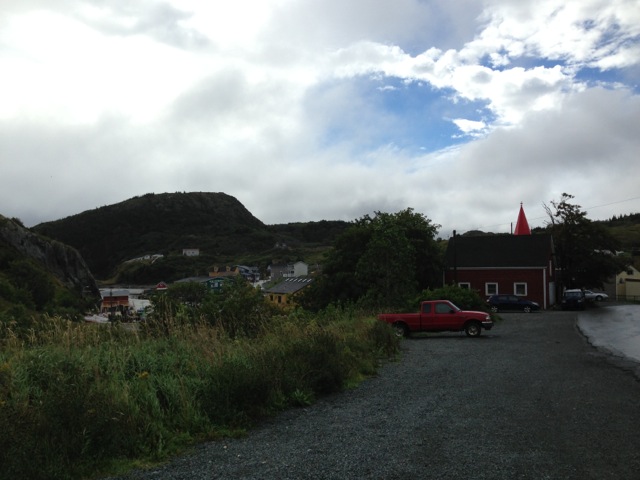
This is where Laakkuluk is.

Matthew: The BC arts council doesn’t support touring within the province.

[To be clearer- The council does not have a program that BC Artists can apply to when touring in BC. The rationale is that they support presenters through the BC Touring Council. The main complaint from SKAM is we are trying to go where there are no traditional presenters. MP]

Laakkuluk: What’s the rationale?

Matthew: Not sure. There is talk of reviewing that.

Laakkuluk: But they do support travel out of the province?

Matthew: Yes.

Laakkuluk: When was your NAC Scene Festival?

Matthew: 2009.

Laakkuluk: Amy says in an email that she can’t get back in.

Matthew: Tell her this is not a metaphor for National Theatre.

Laakkuluk: National Theatre is NOT about exclusivity.

Matthew: No.

Laakkuluk: Did you find that your career and theatre environment changed after the BC Scene festival?

Matthew: Not directly. I noticed companies who appeared there did well. I suppose that benefits our company, but not directly. What about you?

Laakkuluk: Artists from Nunavut really benefitted in terms of exposure, support and self-confidence. I think we also succeeded in showing that Inuit culture is circumpolar and not just Canadian, aaaaand we have at least a couple babies out of the festival!

Matthew: Ha ha, nice

Matthew: How you define circumpolar in terms of culture?

Laakkuluk: Our show had a big focus on how much Greenland and Nunavut have in common culturally despite colonial barriers and so half our cast was Greenlandic and a part of the NAC festival.

Matthew: Ah, neat. Cheaper technology means access to other media that leads to artists dabbling in other forms I think.

Laakkuluk: Technology sure brings this huge country together artistically and in many other mediums. Look at us chatting now!

Matthew: It’s great.

Laakkuluk: Esteemed company I’m in!

Matthew: Thank you

Laakkuluk: Thanks so much!

Matthew: Thanks Amy, wherever you are out East.

The anatomy of our post-corporeal performance experiment

Photo: Michael O’Brien

“Art must grow and flower in the land before the country will be a real home for its people.”

In 1920, at the birth of an art movement that would help to shape a nation, the Group of Seven included the above pronouncement in its manifesto created for their first major exhibition.

Their collective statement is both stirring and problematic. It stirs the heart because it suggests a collectivity that might be possible for Canada. It troubles the heart because history has shown that art had already flowered in the land thousands of years prior to the making of this statement.

Where are we now? How do we dream of a collectivity today? Where will we see ourselves reflected back at ourselves? How can we know one another in all the complexity that each of us brings to a life? And, yes, we must try to understand what we mean when we say us.

When we began this show the “we” meant the two of us. But that “we” has already grown, and “we” (now the more than two of us) hope that this trend will continue. Like the stirring and problematic statements of artists past, we hope that new statements as complex and idealistic can be made here, on the SpiderWebShow.

Is it possible we are beginning to exist in a post-geographic landscape? Even if this is only partially true, creates a lot of questions, and a search for some new governing principles. Dates are important. It’s possible the calendar is replacing landscapes as the chief signifier of our shared reality. So here are some dates that have definitely shaped the given circumstances of the SpiderWebShow:

  • December 21, 2012. Toronto. Café Novo: A first meeting to talk about dramaturgy as social action.

    Photo: Michael O’Brien
  • January 10, 2013. Ottawa. NAC: A first question: Can there be a national theatre in Canada?
  • January – June 2013. Canada: Skype and different cafés: We start to build a show to wrestle with The National Question. Call it the SpiderWebShow. We attempt to build a venue to put it on stage. We set deadlines for opening. We determine that we are not venue builders.
  • July 4, 2013. Balzac’s Toronto Reference Library Location: We meet with our newly-minted digital dramaturg. He will build the venue for our show.
  • July – October 2013. Canada and beyond: Google Hangouts and more cafés (often opening Balzac’s at several 7:30am “in-persons”): Content curated and contemplated. Many elements arranged and rearranged.
  • October 15, 2013 SpiderWebShow.ca opens.

So we live in time. And we imagine space? Even painters needed to imagine a grid to translate what they saw. Maybe now we are learning to apply 1s and 0s (Another way of expressing the grid) to our memory of space.

Theatre, we are told, lives in time and space. Is space, and how we feel about it, changing? How can we, as performance minds meeting at the crossroads of time (which appears to be speeding up but might also be slowing up), and space which seems to be simultaneously shrinking and expanding, respond?

By rooting ourselves in questions and creating a path to follow.

What does dramaturgy as social action mean?

For us it has come to mean creating a space where the possibility of a new kind of Epidaurus, or Circle or Square can exist. We see an ever widening web where performance energy and desire can be concentrated and spread, and where the work itself can grow stronger and more supportive from the breadth of connections made in this space..

How is The SpiderWebShow a show?

Like a show it changes because you are there. It is never ever the same. Like a play with a long run, its shape may be similar to the previous performance, but its essence cannot be repeated. It knows when you are in the audience and no matter how much you love the totality of a moment – you can never recapture it entirely. The SpiderWebShow changes content frequently and changes form with every click.

Photo: Michael O’Brien

This is the most flexible space either of us has ever worked in. Not only is it flexible it is also generative. This means there is flexibility within the spaces, but we can also build spaces to contain new needs of performance expression. The SpiderWebShow turns the axiom on its head and says: If you come we will build it.

What is a Digital Dramaturg?

Graham will be able to tell you more about that then we can. As novel as the title may sound, he has provided us with the tools to express what we previously could only make etchings and hand gestures about. His knowledge and skills, coupled with his sensitivity and interest in online communication, make him a dramaturg ideally suited to provide digital context for the work.

What up with #CdnCult Times?

We want to lead, follow and hold down an editorial place in a National Conversation About Performance in Canada. We hope it will be a place for connecting our editorial stance on issues and ideas of interest, and we want to link our content to all the other publishers expressing similar interests.

The #CdnCult Times is for and by people across this land and beyond geographic borders that contain the imaginary of Canada. If you have an interest in Canada, and performance connected to Canada, then the #CdnCult Times has an interest in you.

What is a Canadian National Theatre?

Can there be a National aesthetic, approach or voice in an art rooted in a multiplicity of identities? As a multicultural bilingual society that spans a continent, is it possible to maintain a collective connection to performance beyond the pastiche of Mounties and Beavers seen in Olympic Closing Ceremonies? What will we become and how can we express this conception “us” – together and separately?

What do we hope to accomplish?

We are in pursuit of the “we”. Our hope is that the SpiderWebShow and – in particular – #CdnCult Times will open up the conversation in such a way that you will be moved to collaborate in the shaping of this new approach to understanding (or creating a new) “us”.

Sarah and Michael