 Marcel Stewart is joined by Sebastien Heins to discuss the glorious ephemerality of theatre, his work with Outside the March, the process of developing immersive experiences, his solo play ‘No Save Points’, the future of performing arts, AI in theatre, Max Tegmark, theatre as an olympic event, our love for Mazin Elsadig, Michael Healey’s podcast ‘Just One More’ and MORE!
Marcel Stewart
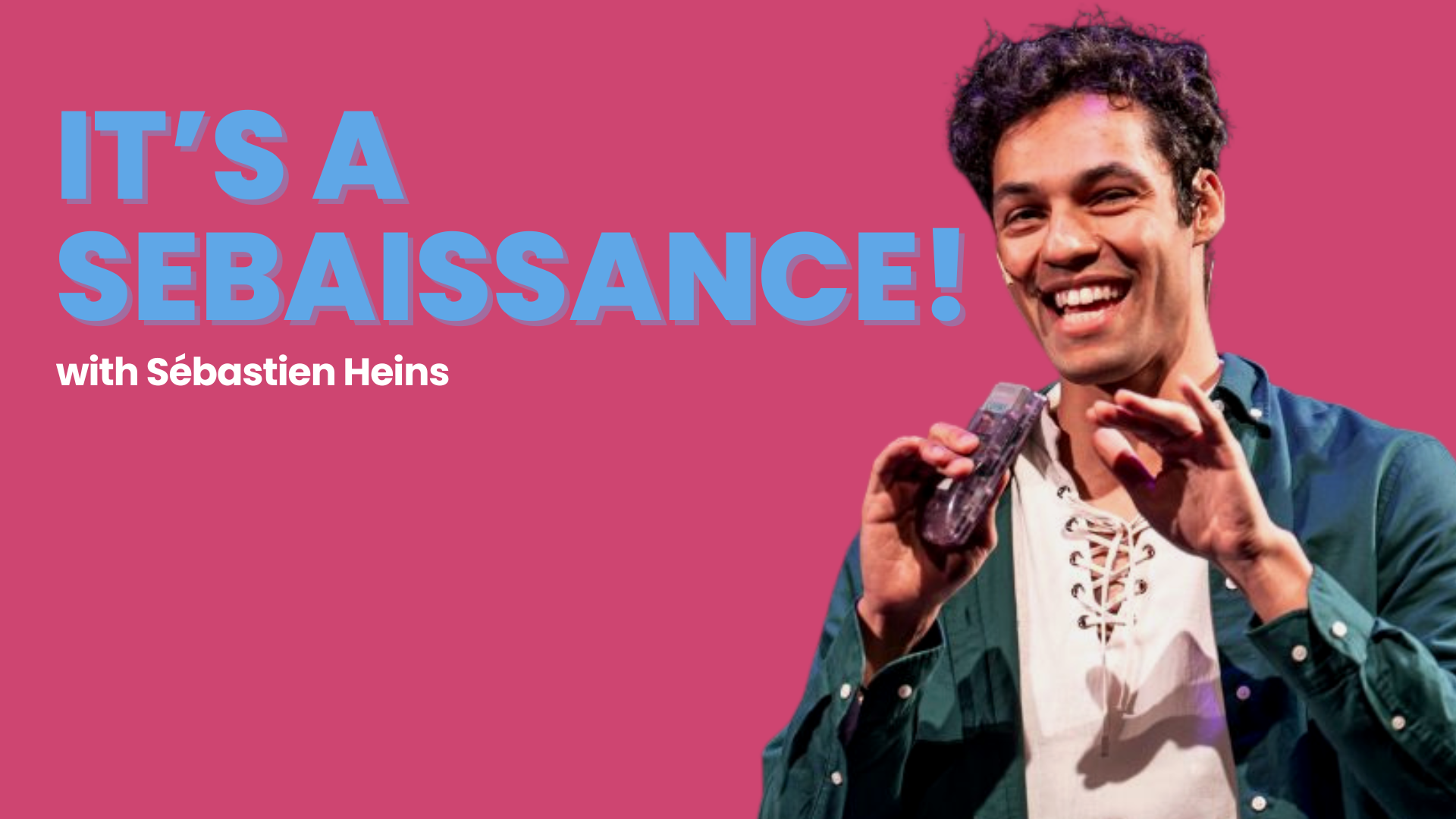
Coming up a conversation with my dear friend Sébastien Heins. We talk about his play no savepoints the process of developing immersive theater, theater as an Olympic event, and our love for Mazin Elsadig. 2023 Is the Sebaissance!
Sébastien Heins
Last time I saw you, you were a gorgeous leader, a fearless leader giving your season opening speeches for b current. I was like: this guy’s got like political people in this room, he’s got artists in this room, he’s got supporters in this room, he’s got his board in this room. Like this is a groundswell. Yeah.
Marcel Stewart
That means a lot. As I hold my microphone… [laughter]. It was a big undertaking. I’m really glad that people that were there, man it felt like affirming for my career and my journey, because so many of y’all, like, were coming up with me. Like so many of y’all in the space or like, we’ve had conversations about what we wanted to do where we wanted to go and like, years later… it was great man.
Sébastien Heins
And like that space has been the epicenter of so much creation for so many people there, you know? It’s got a hand in so many people’s careers.
Marcel Stewart
No doubt. Yeah, no doubt. Okay, let’s, you know, let’s start. And we’ll just whatever, right? So, I’m going to introduce the episode on my own. But, to start us off, I’d love to just give you a moment to introduce yourself however you want right now.
Sébastien Heins
Hi, my name is Sébastien Heins. I have spent most of my career as an actor. I, out of necessity, start to gravitate towards writing and then producing, and more recently, I’ve gotten to try my hand at a bit more directing. So, I exist in sort of a Venn diagram of those four things. Right now, I’m very, very much an actor working on Topdog/Underdog on No Save Points, which is the project that I think we’re going to spend most of our time talking about. I was writer, co director, producing engine, and the performer. I like many hats!
Marcel Stewart
Mulit-hyphenated! Yes! Talk your shit! Talk your shit!
Sébastien Heins
We’re all slashes! We all gotta do it all.
Marcel Stewart
Do you think that is indicative of the times? Like do we have to be slashes in this time as artists?
Sébastien Heins
It’s a good question. Yeah, this is a thought residency… I gotta think! I think it is partially indicative of the times. I mean, I know that I came out of a tradition at National Theatre School, led by Sherry Bie, that emphasized self creation. So we had classes like vocal mask with Damian Atkins and Paul Dunn where we created 8 to 10 minute solo pieces where we played, you know, 20 different characters. And that got our muscles moving. We had solo show with Jodi Essary and Adam Lazarus to create a 15 minute show. You know, that was the epitome of pleasure for us on stage and that’s where Brotherhood came from. So I think that I got the training to say to me, your voice matters and it’s really fun to self create from like a, I guess, like economic longevity standpoint. I think that self creation has a really good chance of like continuing your love of the craft because when you self create you have to wear so many different hats and learn about sound design, set design, marketing, producing, working with venues, performing, audience outreach. You just have to learn all these different pieces of the puzzle and I think it gives you a deeper appreciation actually for like the whole theater juggernaut.
Marcel Stewart
Yeah, yeah, I couldn’t agree more. Yeah, yeah, yeah. [Marcel and Sébastien laugh]. I mean, that’s sometimes it! That’s all we need, you know? Okay. I got a big question for you. I’m curious, and this doesn’t have to apply to theater this is just kind of however the question lands. What are you thinking about these days?
Sébastien Heins
I’m thinking about a lot of things. Thinking about climate change, climate crisis. Thinking about population. Thinking about, why is it so hot in Toronto right now? Compartmentalize that. With Topdog/Underdog I’m thinking about how much time it takes to get really good at a show. How much time it takes to like metabolize material and do it justice. With No Save Points and the stuff that, you know, I get to build with Outside the March, I’m thinking about the glorious ephemerality of theater and the crushing forgetability of it.
Marcel Stewart
Yo, here today, gone tomorrow!
Sébastien Heins
Man, it’s like, if you’re not pushing it up the hill, it’s sinking down the hill. It’s just kind of coming back towards you. So yeah, you know, we had a really, really, really like, life affirming run of the show at Lighthouse Immersive earlier in the summer, and we have some really exciting sort of avenues and options or you know, conversations and things about where the show is gonna go next. But yeah, I’m just like reminded every time I kind of close the show how much it takes to keep pushing a show up the hill. And, I think like, judging whether it’s worth it. And if it’s worth it, you do it. You just do it. You know, you do it because it’s worth it. But I think that it’s good to have that internal conversation about whether or not it’s worth it. And that’s kind of something.
Marcel Stewart
Does that convo happen for you before you agree to do something? Does it happen as you’re doing the thing? Have you ever left or decided it’s not worth it mid-process?
Sébastien Heins
I don’t think I’ve ever really left a process especially after I’ve sort of gone all in on it and said like, “this is happening.” Yeah, I’ve usually been kind of in it doing it. But on No Save Points in particular, such a long process of creating the show. First inklings I got about the idea of playable theater, I was at Soulpepper in beginning of 2019 and I spent a lot of time by myself in a room because like, rehearsal hall, because like my character entered, like after everybody else was going through deaths so I had like a couple of scenes that just, you know, it’s like you’re like, “wow, okay. I guess everybody else is having fun onstage, I’ll just, you know, amuse myself!” So, I spent a bunch of time by myself and I started to play around in my imagination with this idea: what if there was like a room lined with audience members, and I was a solo performer, and they could pick items that would fall from the ceiling? And I would have to then interact with those items, like a video game character does? That was the first time I started playing with the idea. So yeah, like as a project, it’s had a long gestation period, in develop with Mitchell and with the Outside The March crew. I remember relatively early on going, “are you prepared to spend years on this? Because like, right now you’re writing this grant application, and it’s like pulling teeth. And, you know, it sucks. And I don’t want to write this right now. And oh God, is it worth it? Is it really worth it?” Because this is going to be by far, probably the easiest thing that you’re gonna have to overcome along this journey. I really remember going, “I guess this is the thing. This is the thing that keeps me up at night. This is the thing I care about most, creatively, in the whole world. And even if it takes years to see it through, I see myself continuing to be challenged by it.” I have so many questions about how the hell we’re going to make this thing work. How can we make a live video game onstage with a solo actor? How are we going to do that? I just had so much fuel. I think one thing that really kind of cracked things open was realizing how much outside help I was going to need in order to answer that question. And that was going to be its own adventure. Like, I got to talk to people who work at Ubisoft, I got to talk to people who run their own independent game studios, I got to talk to people who, you know, work in Interactive Arts, I got to, you know, work with game developers and, motion capture specialists and animators. I literally went on an adventure and met a whole cast of characters, just to answer that challenging technological question at the heart of the show. And I’m so, so thankful that I got to take that journey.
Marcel Stewart
What other questions came up for you during the process?
Sébastien Heins
A question that kept on coming up throughout the entire writing and creation and development process was: how personal does this show have to be in order to be truthful and deliver the experience that I’m trying to create for people? The very, very, very first iteration of this show, which was in 2019 it was like a 15 minute presentation that I did for Mitchell and people at Outside The March, there was no mention of Huntington’s disease, or my mom or anything like that. It was really all about this person trapped in a prison cell and they had 24 hours to live, and you as the audience got to choose what they did for those 24 hours. And at the end of those 24 hours, they were executed and that that was it. And incrementally, through working with Rosamund and Griffin and Jeff Ho and Mitchell, it just became more and more apparent that there was this deeper, personal story that was fueling the metaphor, and that deeper personal story could have a lot of resonance with a lot of people. So my question was constantly like, how the hell do I do this without boring people with my life? I just really didn’t want to be like, “hey, guys, here’s Sebastian story!” And there’s nothing wrong with that! It was just a fear because I just didn’t want to be that guy. I wanted people to laugh, and I wanted people to feel like they’re taken on a fantastical ride, and that they’d be delighted and entertained and excited and feel catharsis and all those things. But I was really nervous about using my real story. It just felt like what ended up happening was through thinking about it all the time. Like, through trying to answer that question, we realized that all the fantastical stuff in the show, those four games that are, you know, one is on the surface of the moon, and one is in medieval times, and one is in a superhero world, and one is on this, sort of colonial island. Like, in order for the fantasy of those games, to hit home with the audience, there needed to be this bedrock of reality. And it was only through the juxtaposition of those things that both of those things could actually hit their mark. Like, it was kind of one half direct address talking to the audience telling them about what’s happening in my family. And one half, “No! I’m playing a little monster!” You know? And I think that juxtaposition actually brought out the most in the fantasy and brought out the most in the in the reality.
Marcel Stewart
You, mentioned the company Outside the March. Can you talk a little bit about your work with them? Maybe like the work that they do? And on a bigger level, what are some of the questions that you all ask, as you’re deciding what to work on or as you’re embarking on a process?
Sébastien Heins
So, just a bit of context: I met Mitchell, doing Waiting for Godot in university. I was in first year university, he was in fourth year, at university of King’s College in Halifax. He directed me. At like 18 I played Vladimir, just a weird weird age to do it and figure it out, but nonetheless, whatever floats your boat.
Marcel Stewart
That’s right! That’s right!
Sébastien Heins
I just really kind of solidified creative curiosity, I think, between between each other. I met Ishai there too, Simon Bloom, and then Mitchell went to the U of A to study directing, and then I went to National Theatre School, and Mitchell met a bunch of amazing people in Alberta like Amy Keating and Katherine Cullen. And then when he graduated, or actually, before he graduated, we started making shows in Toronto under the name Outside the March under him and Simon Blooms artistic directorship. So, there’s just this host of us from sort of the Kings community and the U of A community who are the founding members, and over the years I helped, you know, build the company, whether that was making the trailers for our shows or helping with marketing and outreach, performing in the shows, Mr. Marmalade and Mr. Burns, all sorts of productions. Vitals was in my parents house, and Roncesvalles. Anyway, years later, I went to Stratford for a while and sort of had to duck out of OTM stuff for a couple of years and then it was sort of like the pandemic hit a bit after that and we started working on Mundane Mysteries, which was our telephonic experience. And through working on Mundane Mysteries every day with Mitchell and crew, it just became apparent to me what a family, what a creative hub OTM is for me and yeah, that’s when Mitchell asked me to take on the Associate Artistic Director position. Yeah, so that’s been my journey from actor to actor, creator, and producer.
Marcel Stewart
And do you think about, like in the future is artistic leadership, artistic directorship, something that you’d like to add to the hyphenate?
Sébastien Heins
I don’t know. I really don’t know. That is not something that I think about. I think about how to make sure that the actor, who is the reason that I’m in the theatre industry, that the actor is energized. You know? And I’m sure that maybe there would come a day when I wouldn’t want to act as much, I don’t know, I have no idea. But I do keep on going back to that performer role. And, yeah, I think it takes a lot of work to be an artististic director, as you know! I don’t know if I would be able to swing both, but who knows. And you had asked about OTM and about our creative decisions, and I did want to just address it. We started as a site specific company, and that sort of evolved into an immersive company. And then over the years, it’s been like 12 years, and that name, immersive, has changed a lot, became a real sort of buzzword, and now it’d be immersive marketing, and like immersive pizza, you know, it’s like, it’s sort of everything is immersive now. We’ve had to continually kind of reinvent what it means to be immersive. And I think for us, it’s always having a deep, deep intentionality about the who, what, when, where, why of a theatrical event. Specifically the where. Like really, really thinking about the where. And something that Mitchell and Rosamund and everybody on the team is really, really good at, and this has been in our DNA since the beginning, is we basically never start with a venue and then find a narrative for it. We start with a narrative, and then try to find the venue that’s going to give the most poetic layers to the narrative and provide the most sort of layered experience for the audience. Case in point, one of our very first shows, Mr. Marmalade: show about a four year old girl and her imaginary friend, Mr. Marmalade, who’s an awful, cruel human or imaginary character. We set it in a kindergarten classroom that we rented from the Catholic School Board. The show hadn’t been done immersively ever before, and it felt like by getting the audience to sit on little kid chairs and drinking juice boxes and getting their tickets from a lemonade stand, and having an ice cream truck pull up at the end of the show, we thought these layers do actually add something to the narrative. And they can help delight and bring the darkness and the light in the show into beautiful stark contrast. Since then, doing a show all about love in the future in a funeral parlor, doing Mundane Mysteries over the phone during the pandemic, somehow liveness, catharsis can still exist over a telephone. Having the set for No Save Points be a gigantic 15 foot tall Gameboy with big buttons that you can jump on. I think that we regularly get really excited by the intentionality of the design of the show. Speaking as AAD I’d call that a bit of the secret sauce.
Marcel Stewart
That’s a great answer. Great answer. Also I know you’re in Toronto because you’re working on Topdog but looking behind you I’d say you are overlooking, like some kind of gorge or Cliff somewhere? What is that backdrop behind you?
Sébastien Heins
What are you talking about? I’m in a condo. I’m in a Toronto condo! Those are the clouds. See all these plants? I found literally all of these in our garbage room. They’re all plants. I found them in our garbage room. People just throw out plants. Like full plants! Like this is a palm that I found. This is a serviceberry tree. These are gorgeous plants.
Marcel Stewart
Did you have to resuscitate them at all? Or like were they alive?
Sébastien Heins
Oh yeah they were on last legs. I was like, “we can do this baby!”
Marcel Stewart
You go! You go!
Sébastien Heins
I love it. Honestly, my favorite thing is getting plants that are on their way out and figuring out how to make them live. It makes me really happy. There’s a vine in the corner there. I think it’s called a lipstick vine. It was like covered in aphids. It was dead. The palm had scales on it. The serviceberry tree gets powdery mildew all the time. They’re my children. So nerdy! You’re just like, “where are you right now?” Like, powdery mildew.
Marcel Stewart
No, it’s great. I just realized this is an audio experience. And so people are not going to be able to see the beauty of what you just showed me. Might have to cut this in post. But no, thank you for sharing. I’m curious if you have any thoughts on the state of theater right now? There’s like, mad think pieces and blog posts and tweets or X’s, whatever they’re called right now, and a company like yourselves like Outside the March, that position themselves kind of at like the forefront of innovative immersive work… any thoughts that you have about where we’re at, in the theatrical ecology? Good? Bad? Or yeah, just anything?
Sébastien Heins
Well, I have to admit that a couple of months after the murder of George Floyd, I had an insatiable appetite for social media. I think like many, many, many, many, many people were, like, extremely helpless and daily fried. And upset and angry. Like deeply angry. And kind of inconsolable in a lot of ways. I can just step away from the socials. I keep profiles on them, but I don’t come back. So I’ve unfortunately missed most of the dialogue and that is both to my detriment and my benefit. I maintain that I wouldn’t have written No Save Points if I had been on social media. I just wouldn’t have. I had so many doubts going into the writing of that show about whether or not I have a voice; should be sharing my voice? Should be sharing my story? Should be even making any theatre at all? I felt extremely doubtful about my place in the theatre ecology and it was only after leaving that conversation that I started to go, “Oh, no, I have something to say. I’d like to make some effort to make something.” I don’t have probably some of the same references that you do, but from being on the front lines of making stuff, seeing audiences come in, talking to them, being part of the theatrical activity. I know that on No Save Points, we knew that that potential hook was going to be people who get excited by the style of gaming and gaming in general, and that those people might not regularly find themselves at the theater. And one of our mandates as a company is to make theater for people who don’t normally find themselves at the theater. And so we ran a ton of Instagram ads, and we had subway ads. I would do these talkbacks after the show and meet tons of people who said they either saw the ads on Instagram, or saw them on the TTC and that this was like their first theater show they’d ever seen. Or, they just like took a chance on it because it seemed cool. And they were they felt really rewarded, that they that they came. And then they brought all of their friends to see it, you know? And came back multiple times. And these are young people of color. These are like young, tech savvy, young people. I remember this Somali girl, and I was like, “how did you find out about the show?” And she was like, “I just I just saw the ad and I was like, that looks like a neat thing!” And I was like, oh, yeah, people do that in cities. They get curious. You don’t have to know them. They don’t have to be coming because they’re your friend. Like people are just looking for cool, good stuff. I think that there’s something to the feat. I don’t have a foot fetish, no. There’s something to the feat. The F E A T. The F EA T!
Marcel Stewart
No shame here, man. No shame here. No slander, no shame.
Sébastien Heins
It’s all love. Literally. But yeah, there’s something to the feat, the F E A T. And I got to see Amanda Cordner in it Snow White and Seven Dwarfs. Did you see that show?
Marcel Stewart
I did see that show.
Sébastien Heins
With Ken Hall, and them playing like all the dwarves. A million characters. And then after the show, they did a talkback with this auditorium full of children and this kid is like, “I have a question!” And Amanda is like, “what’s your question kid?” And the kids like, “Why did you play so many different characters?” And Amanda was like, “Well, you know, because I think that theater should be an Olympic event.” And the kid was like, “Huh!” And she’s like, next question. I was like, yes! Yeah, I do actually think it should be an Olympic event. And that can mean a bunch of different things, whether that’s linguistically or whether that is physically or whether that’s emotionally or, you know, whether that is, in terms of the subject matter. “Oh, my God, I can’t believe that we’re straddling the line talking about this really difficult subject. This is an Olympic event right now.” I think theater is most exciting and most palpable when it feels like the possibility of risk and failure is constantly staring you in the face! And I think that that’s attractive to people. I think that they get excited sitting in an auditorium experiencing that. And I think that at OTM there’s always this kind of conversation that starts to happen where we start to create challenges for ourselves. Like we start to impose these obstacles that we think fit, you know, within the creation process? That we think fit in the project. Things that are going to make our lives really, really, really friggin difficult, but that create a sense of feat. On Mr. Burns, a Post-Electric Play, we attempted to do the whole show without electricity from the grid. So like, one design element from the first act of the show was that instead of having cricket sound effects, we literally had boxes of crickets throughout the audience. On vitals, we wanted an ambulance to show up at the end of the show and we had to figure out how to safely hide an ambulance in the back laneway, so that it wouldn’t obstruct traffic, and so that we could bring it in for the finale of the show. It’s like a three minute moment. But it was the final bang. So much logistics went into that, but it was it was worth it. It was a feat. And I think people were delighted by that. You know, Mundane Mysteries, same thing. How to tell this personalized story about you and your mundane mystery over the course of six telephone calls with a bunch of different actors who all are sharing information and writing this mystery just about you and your life during the pandemic. All of this stuff, it feels like a feat. And I think out of feats come magic and miracles. And I think that’s what a lot of people are looking for when they go to the theater. So I guess this is a big roundabout way of saying: I don’t know what the state of theater is. I don’t know how we’re going to make any of these models work. However, I still think that there is a beating heart to it, that is attractive to people. And so, as long as they want to come and as long as we want to tell our stories, we should keep doing it as long as we want to. I know, it’s so much more complicated than that.
Marcel Stewart
But I’m not speaking to any of those people that have complicated, whatever answers. I’m speaking to you! And your answer is the answer. And you’ve given me like so many things to think about and respond to. But I think my first thing is, I’m going to put on my MCU, comic book, nerdom hat on and ask you… This guy! He’s ready! He’s ready to go! So if you were the sorcerer supreme, and you’re walking around with the time stone just dangling around your neck, and you have the ability to jump in time 50, 100, 200 years. What would you want theater to look like? What would you want from theater?
Sébastien Heins
Oh Boy.
Marcel Stewart
I know. Doing it!
Sébastien Heins
What I want from theater? I mean, is it weird that my first thought was, I would hope, that the AI and the robots would have their own theatrical traditions by then?
Marcel Stewart
Okay.
Sébastien Heins
Is that weird?
Marcel Stewart
It’s not weird at all. Can you expand?
Sébastien Heins
Yeah, like if they are to become such a big part of our society and potentially gain some sort of sentience due to like, the quantum leaps in computing that are happening. I assume, rightly or wrongly, that they’ll become some part of the population and that they will interact with one another and that they’ll either integrate into our society or will be draconian, awful, humans and stick them in their own little cages. Or maybe they put us into cages. I don’t know about that. I don’t know what’s gonna happen. But, I think that there will be a relationship between what is sort of a-human and what is human. And I would be interested to know if that a-human, non human, population carries on the tradition of performing for each other. Yeah. There has been actually quite a bit of AI theater made at this point. Text generators, from GBT-2 to ChatGPT just like cranking out plays. To people many years ago sticking two computers onstage and having them talk to each other, with no humans involved. It’s not like the machines instigated those experiences, but I don’t think that we’re super far away from them creating your own theatrical traditions. I saw a robot doing improv with a guy. I was like, “this robots got jokes! Funnier than me!” I think that would be interesting. And how interesting would it be as a human to see that and experience that? So, yeah. 200 years from now that’d be interesting to see what what they’re making.
Marcel Stewart
You come across the, I think it’s like, the 24 hour a day Seinfeld loop? That’s an AI?
Sébastien Heins
Oh! Yeah, yeah. Yeah. Yeah. It got super racist, didn’t it?
Marcel Stewart
Yeah, they shut it down.
Sébastien Heins
Yeah, right. Yeah. Right. Yeah. Yeah. It went on like an anti-trans diatribe or something.
Marcel Stewart
Yeah. Which, you know, just has me thinking of what you’re saying about traditions and like, the limitless possibilities of what can happen if we give AI the chance or the opportunity to continue evolving as it does. There’s a fascinating, kind of harrowing, book Life 3.0 by Max Tegmark. He’s like a engineer… smart person… who essentially… [Sébastien and Marcel laugh]. Yeah, I know. I got no words to describe this like really intelligent guy. I’m gonna have to edit that out.
Sébastien Heins
Got a PhD in smart. [Sébastien and Marcel laugh again].
Marcel Stewart
Oh god, why am I hosting.
Sébastien Heins
No, you’re killing it. You’re killing it.
Marcel Stewart
Thanks, brother. Thank you.
Sébastien Heins
You read a book, bro!
Marcel Stewart
Yeah, I read a book likefive years ago. It’s an old book! Came out like 2015-2016? I haven’t read recently! Who has time to read!
Sébastien Heins
Like the one book you talk about for five years.
Marcel Stewart
It really is.
Sébastien Heins
Very smart, man. [Sébastien and Marcel laugh].
Marcel Stewart
He’s probably written three books since then, you know? Like, I’m still so behind.
Sébastien Heins
I’m the same man. I am just on audiobooks. I look at a page and I start falling asleep. I’m embarrassed.
Marcel Stewart
No! I just read recently, Spotify is jumping into the audio book domain to try and take away from the monopoly that Amazon has. And it was talking about like, books and potentially magazines and comics. I’m like, the audio play? The audio drama? Can that reach mass appeal? Or is it still just a niche? I mean, PlayME still makes content.
Sébastien Heins
That is friggin amazing. I love what they’ve done. I think they’re amazing. Like I grew up listening to audio dramas on CBC. And then CBC got gutted, and those completely disappeared. And it was like, “are we never going to have those again?” And then PlayME came in, and they’re like, “I got you.” It just totally brought it back. Anyway, sorry, you were saying?
Marcel Stewart
I was on a flight recently and in preparation for the flight, I downloaded, like six fictional podcasts in the hopes of inspiring my creativity. And, they’re all somewhat in the science fiction realm, which, I like, but felt very similar. I felt like, I know, people that could write better than this. I know actors who could act better than this. I don’t really have a question. I hope if I’m going to prognosticate, if that’s even a word, I’m going to think about what’s going on.
Sébastien Heins
It is now.
Marcel Stewart
That’s right. That’s what I thought! I’d like to see more theatre writers, more playwrights, creating, I’m going to use the word ‘content’ in a nice way, just like reaching more people. Going back to what you were saying about this love and passion for what we do as theatre makers, and also kind of grappling with or accepting the finality of it. It happens and then it’s gone. And if you’ve had the chance to see it, you’ve had the chance to see it, but if you’re not a part of that moment, then you don’t get to witness the moment. My insides are like, “Ugh!” I think that’s like the death knell of theater. Now, there’s such an access, there’s such a availability of things to see and people’s schedules and lives are so hectic. If you’re not able to find time to get to the theater to see the show, you’re shit out of luck. I think there was a time when that was really exciting and it made it exclusive. But now I’m like, “Ah, are we missing out on audiences by pigeon-holing, making up another new word, ourselves into a particular moment?” I don’t know. Is any of that resonating?
Sébastien Heins
Yeah! Oh, dude, it so resonates. I really, I have been thinking about this a lot since like, I think like 2015-2016, when 360 video and sort of VR was really trying to make its last big push. I got really excited about 360 video, because I thought that it could maybe capture the depth and the feeling of presence in a theater show for audiences. So you could put on your headset, and you could watch a theater show as it was kind of meant to be seen and experienced. God, but like, it’d be so much easier to do this theater thing, if it just wasn’t theater. Like it would be so much easier to do it if it was like recorded and we could get a bunch of great camera angles on it and re-record the audio and have like these interesting tech elements so that people can like share and post it around and move it around a place online. Like it would just be part of the digital conversation. Especially at OTM we keep on coming back to, this really happened during the pandemic, was: it’s always the liveness. It’s always the liveness that’s the thing. The liveness is the reason to do it. Because the liveness brings with it all of these extremely tricky obstacles to get around. How the hell do you do something live continuously? It starts. Everybody comes out. They do their thing. “Oh my god, I can’t believe it’s still happening! Oh my god, it’s so hot! They’re still on stage! And he just came in and oh my god, there’s an elephant up there? Oh my god and it’s over. Wow!” Right? And they did it live. From a caveman like, ‘ugh, ugh,’ perspective, I think that’s just the thing about it that’s so exciting. Every time I try to sort of figure out how to make theater that fits within the way that people consume media now, it just feels like the live thing has to go. That doesn’t mean that there aren’t ways. People are constantly figuring out how to use live streaming methods in order to make theater exciting and interesting, or have the theater sort of exist within social media or within the comment sections. There’s so much to do, and it’s really, really exciting. And all the generations are figuring out how to do it. And there is no one way to do theater. But I do think that the liveness is both the emancipator and the shackles in this world that we worked in. I think that there’s something to soundtracks. One of my favorite success stories, I guess, it’s kind of, basic or sort of mainstream at this point today, but just the fact that Hamilton came out as a soundtrack that everybody could listen, to learn the words of, fall in love with before they could ever see it. I just think that that’s one of the coolest success stories. It’s made such an impact on so many people. And I sometimes wonder, okay, like, what is the theater version of that? Where you have a drama and somehow you want to get people excited about being in the drama. Sometimes I wonder whether we should be filming scenes from the shows that we do? You know what I mean? I feel like most of the time, we do sort of a supercut of a bunch of little things throughout the show, and then sort of give that to audiences to get them excited, but I think it’d be so cool to maybe focus on a 30 second scene.
Marcel Stewart
That’s good, that’s good, that’s good. Who inspires you creatively or artistically?
Sébastien Heins
You! You! You!
Marcel Stewart
Stop it! Stop it! Stop it!
Sébastien Heins
You are a very inspiring individual. You got the languag. You got the language your. Your way with words. It’s gorgeous,
Marcel Stewart
Oh man. Appreciate you. Thank you.
Sébastien Heins
And you never give up. I remember when we did that b current… [Marcel and Sébastien laugh]. We started with what? Two kids? Two kids in that program?
Marcel Stewart
Two.
Sébastien Heins
And then one of them left, like, halfway through. He just like, never came back. And I saw him! I saw him in the streets! And I was like, “What are you doing?” But he’s like, “I got into a short film.” Like, I understand, but fuck you man!
Marcel Stewart
Hey could just let us know though?. You can’t just like, hit us up? Let us know? Waiting for you man!
Sébastien Heins
Yeah, that was wild. But you were always so like, “we’re still gonna do this. And we’re gonna make it happen and it’s gonna be enriching and we’re gonna put all of our energy into her. Now that we just have one participant.” So yeah, you’re a wonderful person.
Marcel Stewart
Thanks. She’s killing it now by the way, she’s killing it.
Sébastien Heins
Is she?
Marcel Stewart
Yeah, she’s like, creating her own work and taking it across the country. She’s slaying it right now.
Sébastien Heins
Wow!
Marcel Stewart
Yeah! Yeah.
Sébastien Heins
Okay. Yeah. Whose fault is that? We could take responsibility… no I’m kidding. Yeah, who inspires me? Just on a really practical level l find Mitchell really inspirational. As they say in Hamilton, the man is non stop. He’s just relentless. Loves it so much. Loves it. Without him, No Save Points wouldn’t exist. He’s just such an incredible artists. So curious all the time and just always ask the hard questions and is excited by creation. So I am really inspired by Mitchell. Mitchell Cushman. I’m inspired by, I have to say this, I’m inspired by my mom. She has been handling a very challenging situation for a long time and still makes me laugh, and is still inquisitive and curious and herself. She’s herself, in spite of what she’s going through, and I just adore her for that. And even if it was, you know, quote, unquote, “affecting’ her more, or getting her down more, any of these different things, I would still be really proud of her. I just think that she’s, yeah, she’s quite an inspiration. I’m inspired by my amazing wife, Dasha. I feel like she eats shit all day at work, she just like, constantly has to manage personalities, and she works unbelievably hard and still somehow comes out on top at the end of the day. Round the clock, and is so well liked and admired by the people she works with for very good reasons and she continues to be an advocate for athletes in a major way. She’s been working with the new Women’s Professional Hockey League getting their players association off the ground, as well as working with the national men’s soccer team and continuing work with amateur athletes. From early on in our relationship, we realized that her life as an amateur athlete and my life as a performer and a theatre artist, have some real similarities and I continue to be amazed at her fight to advocate for the plights of athletes. And she sees more theater than most theatremakers I know! She loves the arts. She loves theatre. She’s bringing tons of people to Topdog. I’m just really inspired by how she always has room for care and love, and she inspires me. Creatively, I watched Brother the other day? Have you seen Brother? Clement Virgo? And Mazin’s in it.
Marcel Stewart
Of course he is.
Sébastien Heins
And he’s so scary. And I watched it and his character was like, aggressing the main characters. And I’m like, “in Topdog, this is the shit I have to deal with every day! This is the shit I deal with all day!” This guy aggressing me onstage. I was really inspired by Brother. I think it’s a really good movie. And Mazin is great in it. The main actors in it are really good too. Aaron Pierre just came onto my radar and I think he’s really, really good. He’s a great actor.
Marcel Stewart
True story about Mazin, that he may have shared with you, and this may make the episode or not, who knows? Brother Size, that I was fortunate and privileged to be in pre pandemic.
Sébastien Heins
And kill! You were so good.
Marcel Stewart
Oh, bless bro. Thanks. Man! The Marcel flowers residency, you know? But yeah, we lost one of our brothers who became ill and needed to prioritize his health during the process. And that happened, like, a day before tech week. So we began a search to try and find someone to come. We auditioned people and it just wasn’t a fit. I don’t know how Weyni connected with Mazin, it might have been Virgilia Griffith I think, but when he came into rehearsal, I remember it was like, “okay, so we found someone and he’s coming from California.” And we’re like, “Oh?” and she was like, “Yeah, so we’re gonna schedule an extra rehearsal. And he’ll probably be on book but you’re great. And like, just welcome him into the fold.” He got there on a Sunday, like he got there Sunday morning, script in hand. We did a read. We like, tried to start blocking. Dog, by Monday, he was off book. By Monday! And He. Was. The. Lead. Of the show! It’s an ensemble piece, yes, but he had at least 60% of that text. Off book, bro! And so like, from, you know, Monday until we opened the show on Thursday, and we had audiences come in Wednesday and Thursday, by the time we opened the show, we’re just you know, blocking, tweaking, adjusting. And he was so like, “Yo, if I’m off, like, move me to where I need be. Can we run lines on break? So he elevated my game. He elevated Aaron’s game. And kind of just brought us together in a way that I didn’t think was possible because the three of us before Mazin arrived were already so close from the work that we did in rehearsal ,but it required a whole nother level of work. And also the idea of letting go: going back to this idea of liveness, going back to like what we’re talking about, about the finality of things. Also being comfortable with letting go, you know, like, we’ve built the show up over three weeks of rehearsal with Tommy in the space, and I was like, “this show is going to be fucking fire!” And then like, you have to move on? And no shade to Mazin, but I was like, “What is this guy gonna do?” He’s gonna come in like, “how are we gonna make it work?” And Mazin was like, “Yo, I’ll show you what I can do.” And I couldn’t have seen that, you know? I’ve always been like, “Yo, anyone needs an actor? It’s Mazin Elsadig, without a doubt.”
Sébastien Heins
He’s very special. He’s the man on Topdog. He’s been my inspiration on Topdog throughout. He’s like, such a beautiful scene partner to spend time with, create chemistry with. Yeah, I absolutely adore working with him and I think he’s the truth. I had heard those stories. He had told me about having nine days to learn that whole show and he was like, “that’s how much time I had and I just, like, had to do it!” He was like, “I didn’t know how I was gonna do it, but I knew I had to do it.” I think that’s how he approaches a lot of things. He just kind of throws himself in. He really prioritizes authenticity and truthfulness, and like, “could I see myself doing this in real life?” The amount of depth you can find while also learning so much so quickly is amazing. Yeah. I’ve learned a lot from him on this process. A ton. Yeah. Mazin, baby!
Marcel Stewart
Yeah! Yeah! Couple more as we round out our time here. A couple more. I was listening to Michael Haley’s podcasts, and he had Evan Buliung on there. And they’re talking about Evan Buliung’s experience working on Lord of the Rings and it was quite an effective listen, if you don’t know that story or anything about the show.
Sébastien Heins
I saw that. I never heard.
Marcel Stewart
Oh, whew, take that in. It’s a good listen. As someone who also saw it, and was like, “wow! This is quite the spectacle!” To learn, like, so much shit was going on behind the scenes… yeah. But Evan said something, “every experience changes us.” Which, yes. And so, I was thinking like, my question to you would be: how has No Save Points, creating and/or performing, changed you artistically on the human level?
Sébastien Heins
Well, I think it’s a lot of things. And some things I will probably not understand for many years, actually. We’ll have to do this again, in like 10 years.
Marcel Stewart
Thought Residencies 3.0!
Sébastien Heins
Now featuring AI.
Marcel Stewart
We’ll meet in the future.
Sébastien Heins
They’ll talk. Yeah, they’ll talk. Yeah, I’ll be super honest and say that when I got to create Brotherhood with the team that I got to work on it with, that show is and became such a sort of showcase for what I love in theater. It became this, real place for my identity. A show that I wrote, and that is a solo piece, music and lyrics that I’d created with, Mickey and a really great team. I think that I was really nervous after having performed it a number of times and feeling people really liked it, and I was nervous. Will I ever make another solo show and not repeat myself? How am I going to evolve in this art form? I’m really floored by the process that we went through to make No Save Points because it required me to not just bring everything that I learned about vocal mask and solo storytelling, from Brotherhood, but I had to learn all these new skill sets. I had to learn about all these other roles on the project, I had to become a video game level designer. I drew out the sidescrolling levels for the third game and worked with Damien Atkins on hopeful monsters’ choice trees, and worked with Alex Lyons, this amazing Illustrator, to come up with the visual world of the superhero characters. There’s so much creativity that went into the show that stretched me beyond the artists I thought that I was. Brotherhood is and was an extraordinary feat for you as like a young, emerging artist-creator, and it’s so wonderful that I got to perform it so many times in so many places, and that people really enjoyed it and sort of continue to be excited by it. I continue to have things to say, artistically. I continue to have creative challenges that are exciting for an audience to watch. I think that in the worst of times, that fear that you have pigeon holed yourself can be really kind of debilitating. And you kind of go, “oh God, I have to top that somehow.” The act of building No Save Points wasn’t the act of topping it. It was the act of relentlessly following my other curiosities and getting inspired by our incredible team. To go in that direction, “oh, my God, how do you make a live video game on stage? How do you do it? What do we attach to my body in order to make that happen? What are the visuals for the side scrolling game?What are the colors that signify each of the different games?” I just found that following curiosity ended up answering the question whether I’ll ever make something exciting ever again. I did. We did. Because we were following our excitement. Because I followed my excitement with a lot of really exciting people, I got to make something that I’m very, very, very, very, very proud of. Does that make sense? Kind of a long winded answer.
Marcel Stewart
No, no, again, great answer. It makes sense. I think it’s the thing that university classes will share with their students, right? Follow the excitement. Follow the excitement. On that note, what matters to you most as an artist?
Sébastien Heins
Tawiah, who directed TopDog/Underdog, shared this with me and I said, “Oh, yeah, that’s sort of my mandate when I go into a process.” I think that a lot of people share this: that the people involved in the show are proud of their work at the end of it. That feels like a really good barometer. If you do a show and lots of people comment it’s really successful, but you kind of hate your life and hate yourself and hate it, something’s I think gone wrong. But if you do something and the sound designers like, “Yeah, I did something that I’d never done before on this one.” Or the costume designers like, “Oh, I really, really love this thing that I did. I think it really supports the piece beautifully.” And the actors are excited to be there every day, and everybody’s proud of the work, that’s the thing, I think. Because I really do think that translates to the audience experience. I do.
Marcel Stewart
Totally.
Sébastien Heins
Yeah. Because, kind of going back to that idea of the feat, if you’ve accomplished a feat on stage live in front of an audience, you’ve slain some sort of dragon or conquered some kind of difficult obstacle and challenge and that is palpable to the audience. They can feel that something really difficult has been achieved or climbed and they get invested in it too. And I think often when we slay a dragon we’re proud of having gone through the suffering and the uncertainty that is the creative process.
Marcel Stewart
No one’s gonna come. [Sébastien and Marcel laugh]. It had suffering. “This is the worst idea ever. Why did I do this? No one’s gonna come. I’m so stupid!” Yeah, no, no. What’s next for you?
Sébastien Heins
So we’ve been extended to October 22, which is very cool. So I think by the end we will have gotten maybe between 25 and 30 shows, including previews. Which was really fun, especially for a show like this. I have a week off, and then I start Sweeter by Alicia Richardson, which is a great, great. TYA play that I got to perform over Zoom with some amazing actors during the pandemic for some young people and like, fell in love the script. It’s so good. Alicia is such a good writer. Really, really talented. So Tanisha is going to be directing that and Amaka is going to be co directing or assistant directing which is really cool. I think Daren Herbert’s gonna be in it, Emerjade Simms. Some really, really, really, really great people. So I’m looking forward to that and that’ll take me to the end of December. I get to play a villain in that. This sort of plantation owner type character who’s also mixed race. It’s like, just after the Emancipation Proclamation in the States and there’s this family who used to work the land who now want to purchase land, and they’re finding that they aren’t able to do so because of, you know, the way that the States is so impossible in that period for people of color. So my character is interesting, he’s got one half in the Black experience and one half in the sort of white slave owner structure experience. I’m excited to be a bad guy.
Marcel Stewart
I met with Alicia last week and she mentioned that you’re gonna be in her play. I don’t know if I said this out loud or if I said it in my head, that this feels like a Sebaissance? Like Sébastien Heins Renaissance? And I say Sebaissance besides, like, Renaissance. Sabaissance. Because I feel like I’ve known you for almost 10 years, but there was a period when you were away at Stratford, but then you also went to Chicago, and I know you’ve been working but, you’ve been working around! From No Save Points, to Topdog, to Alicia’s play in Toronto. I’m just like, “fuck yeah!” We should be seeing more than that! Let the Sebaissance begin!
Sébastien Heins
That’s really kind. It certainly has been a big year. I’m very grateful for it. Grateful for the caliber of artists that I get to work with on all these projects. You know what it’s like. That’s really what makes it what it is. I don’t know man. This kind of semi post-pandemic. thing, I feel like there’s a lot of emerging or reemerging going on. Like the bamboo. I heard the thing that bamboo just stays in the ground for a long time and then one day it just shoots 20 feet into the air. It just explodes. I think that’s been happening for a lot of artists. You included. One day it’s like we’re all farting around behind our computers during the pandemic and the next day you’re leading one of the most exciting companies. Where did that come from? Your’s is gonna be the Marcel-at-thon. The hot hot Marcel summer.
Marcel Stewart
Oh God no! Hot-cel Summer. I like it. Hot-cel Summer!
Sébastien Heins
Hot-cel Summer! Hot-cel Summer!
Marcel Stewart
I’m here for it. I’m here for it. I want you to have the last words here, because this is your thought residency. Are there any final thoughts or words that you want to share?
Sébastien Heins
This has just been such a great conversation. A very good conversation. I feel very well-taken care of. Other things that I want to say or things that I have been thinking about… you’re gonna spend the whole three minutes just in silence!
Marcel Stewart
We’re all reflecting on the pearls you’ve dropped!
Sébastien Heins
Yeah. I was listening to Smartless. Do you know the Smartless podcast? Yeah, it’s so silly. With Jason Bateman.
Marcel Stewart
They’re taking it on the road. They’re going on tour, live.
Sébastien Heins
Yeah! They interviewed Willem Defoe, I think a couple of weeks ago, who has an incredible theater pedigree and is totally a theater animal. Like you listen to him talk and he just feels like, for lack of a better term, he’s one of us. Which is really refreshing. Sometimes on Smartless when you’re like, “Oh, this is such a LA crowd.” And to hear Willem say things like, “yeah, I don’t take my cell phone onto set. That’s not the place for it.” I just love that. Anyway, so Williem, he was talking about how when you get to perform, it’s a really weird existence being a performer. Because I think as most performers know and feel, a lot of life kind of passes, not passes you by, but you engage with it somewhat passively. But the time that you spend on stage is some of the most charged, exciting moments and seconds and times in your entire life. It’s like life on steroids or something. You’re so present. And the audience makes it like that, and your scene partner makes it like that, and the material makes it like that. And I guess my last thought would be that being a performer is certainly a lot of work and it is an extraordinary privilege to because you do get to live a heightened life onstage for two and a half hours sometimes if you’re lucky. And I’m feeling a lot of gratitude for being able to live so…the only word I can think of is miraculously. Yeah. I think that’s something that we in this industry get to do. And I’m really thankful for that. And we get to do it with and through the audience all together. ally. It’s as I said before, there’s a huge amount of suffering sometimes involved in in getting these things on their feet and I think we do it because it’s ultimately worth it. And because the seconds of life that we live on those stages give us a double life. We sometimes live for 100 years on stage. It’s really amazing